
Desoldering methods - which one suits your part?
Whether it is a through-hole part, an SMD resistor or a multi-pin IC, each component has its ideal desoldering technique. This guide compares solder wick, solder sucker, desoldering station and hot air and shows when each method is the best choice.
View desoldering toolsWhat happens during desoldering?
Desoldering means remelting the solidified solder and removing it from the joint so a part comes off without damage. What you need is enough heat, fresh flux and a way to carry off the molten solder - by capillary action, vacuum or a stream of hot air.
Leaded solder (Sn60Pb40) melts at around 183 °C, lead-free solder (SAC305) only at about 217 °C. That is why the working temperature usually sits between 270 and 350 °C, depending on the alloy and the mass of the joint. Large copper ground planes draw heat away quickly and need more power.
- Capillary action: solder wick soaks up molten solder.
- Vacuum: a solder sucker or station pulls the solder away.
- Hot air: melts all pins of an SMD at once.
- Always heat the old solder through first, then remove it.
Wick, sucker, station or hot air?
The four common methods differ in effort, precision and the type of part they suit. Single joints call for cheap hand tools, while multi-pin parts justify a station or hot air.
- Solder wick: copper braid with flux, widths of 0.5 to 2.5 mm - use narrow braid for fine pads.
- Solder sucker: spring-loaded vacuum, ideal for quickly clearing single through-hole joints.
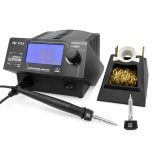
- Desoldering station: combines a heated hollow tip with continuous vacuum, the cleanest option for boards with many pins.
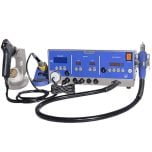
- Hot air station: 300 to 400 °C and an adjustable airflow lift whole SMD parts without contact.
How do I pick the right method?
Your choice depends on the package, the pin count and the value of the part. A single electrolytic capacitor comes off with a sucker or wick, while a 44-pin QFP only makes sense with hot air.
What matters in daily practice?
Clean results depend on the right tip or nozzle size, fresh flux and the correct temperature. Working too hot damages the traces, working too cold tears pads off when you pull the part.
- Clean and re-tin the desoldering tip and suction nozzle regularly, or heat transfer drops.
- Always use a fresh section of solder wick - a saturated braid stops soaking.
- Clear the station vacuum channels of solder residue after each session.
- For lead-free solder, set the temperature 20‑30 °C higher than for leaded.
- Remove flux residue with isopropanol after desoldering.
Frequently asked questions
Solder wick or solder sucker - which is better?
They complement each other. The sucker quickly pulls larger amounts of solder from through-hole joints, while wick cleanly lifts fine residue from SMD pads. For boards with many pins, a desoldering station is the most comfortable solution.
What temperature do I need for desoldering?
Usually 270 to 350 °C. Leaded solder melts from 183 °C, lead-free from 217 °C, so the working temperature sits higher. Large copper planes need more heat and power.
When is a hot air station worth it?
Whenever you work on SMD parts with many pins such as QFP, SOIC or BGA. Hot air melts all leads at once and lifts the part without contact, without stressing individual pins.
How do I protect parts while desoldering?
Short contact times, fresh flux and an ESD-safe bench are key. With hot air, cover neighbouring parts with Kapton tape and keep the airflow low.
Looking for the right desoldering tool?
From solder wick and solder suckers to desoldering and hot air stations - we supply the right tool for every joint.
For every task
Tools for THT, SMD and the finest pads.
Precisely controlled
Stations with stable temperature control.
ESD safe
Dissipative versions for sensitive parts.
Selection help
We help you choose the right products; technical details are clarified with the manufacturer.