
How to choose an electrostatic field meter for ESD control
An electrostatic field meter measures surface voltage without contact and reveals hazardous charges. This guide explains the selection criteria range, measuring distance and resolution, and shows how to assess ionizers to DIN EN 61340-4-7.
View field metersContents
What does an electrostatic field meter measure?
A field meter senses the electric field of a charged surface without contact and, at a known distance, converts it into a voltage in volts or kilovolts. This lets you detect charges on components, packaging or work surfaces before a damaging discharge occurs.
Because the reading depends on distance, every meter is calibrated to one fixed measuring distance, often 25 mm. The value is only correct at exactly that distance. A chopper-type field meter (field mill) gives more stable readings than a simple induction sensor.
Range, distance and resolution - what matters most?
Three criteria decide suitability: the range must cover the expected voltages, the measuring distance must suit the object and the resolution must reveal small residual charges. For the EPA a range up to 20 kV is usually enough, while ionizer checks depend above all on a fine resolution near zero volts.
- Use a spacer or target cone so the calibrated distance is held reproducibly.
- Choose a hold function for measuring points that are hard to read.
- A polarity display (+ and -) is essential, as charges of both signs occur.
- Plan annual calibration with a certificate, otherwise readings drift.
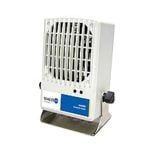
How do you assess ionizers to DIN EN 61340-4-7?
DIN EN 61340‑4‑7 defines how ionizer performance is measured. The tests cover the decay time from 1000 V to 100 V and the offset voltage (residual voltage at balance). This uses not a normal field meter but a charged plate monitor (CPM).
The CPM charges a defined plate to +/- 1000 V and measures how quickly the ionizer discharges it. Short decay times and an offset voltage close to zero volts mark a well-adjusted, symmetrical ionizer.
- Decay time 1000 V to 100 V, target often under 5 seconds depending on the application.
- Offset voltage (balance) ideally under +/- 35 V at the EPA.
- Measure at the working distance of the bench, not right at the emitter.
- Clean emitter points regularly, then measure again.
How do you measure correctly in practice?
Reliable values only come from a constant distance, a dry environment and a grounded operator. Hold the field meter perpendicular to the surface and avoid touching the object first, or you will change the charge yourself.
Frequently asked questions
Why must the measuring distance be held exactly?
The meter is calibrated to one fixed distance, usually 25 mm. Because the reading falls with distance, even a small deviation distorts the result. A spacer keeps the value reproducible.
Is a field meter enough to test ionizers?
No. Assessment to DIN EN 61340‑4‑7 needs a charged plate monitor that measures decay time and offset voltage on a defined plate. A field meter only shows the field strength at a surface.
What resolution should a field meter have?
For general EPA checks 10 V resolution is enough. For fine assessment of ionizers and residual charges near zero volts a finer resolution is an advantage.
How often must a field meter be calibrated?
Annual calibration with a certificate is standard. Only a calibrated instrument gives standard-compliant, defensible readings for your ESD control program.
Looking for the right field meter?
We supply calibrated field meters and charged plate monitors for charge and ionizer testing to DIN EN 61340-4-7 - with a calibration certificate.
Standard compliant
Testing to DIN EN 61340-4-7 covered.
Calibrated on delivery
Field meters with calibration certificate.
Measurably safe
Spacers for reproducible readings.
Selection help
We help you choose the right products; technical details are clarified with the manufacturer.