
How to mark ESD zones on the floor and define the EPA
Floor marking makes the boundary of the ESD protected area (EPA) visible and controls who enters it and under what conditions. This guide shows how to mark EPA boundaries with dissipative tape, which warning signs and symbols belong to DIN EN 61340-5-1 and how to enforce access rules.
View ESD floor markingWhy must the EPA boundary be visible on the floor?
The EPA (ESD Protected Area) is the zone where every measure against electrostatic discharge is in force. Its boundary must be clearly recognisable so nobody enters unprotected and no charge-generating materials are carried in. Floor marking draws that line visibly on the ground.
DIN EN 61340‑5‑1 requires the EPA boundary to be identified and access to be controlled. In practice a continuous tape frames the zone, backed up by warning signs at the entrances. Staff and visitors then know immediately where the protected area begins.
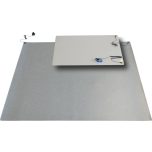
Which tape and colour for the marking?
There are two options for floor marking: dissipative marking tape that forms part of the EPA surface, and purely visual warning tape that only shows the boundary. Inside the zone the tape should be dissipative so it does not interrupt the potential of the ESD floor.
- Yellow-Black signals a warning and boundary zone and is the most common choice.
- Green-White or solid green marks the safe interior of the EPA.
- Dissipative tape inside the zone prevents an insulating interruption.
- Floor symbol signs (ESD triangle) reinforce the line at entries and exits.
- Choose slip resistance of R9 or better for walked-on surfaces.
Which signs and symbols belong at the zone?
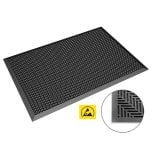
Every entrance to the EPA needs a warning sign with the internationally standardised ESD symbol: a triangle with a hand inside an open circle segment. It signals that the area is sensitive to electrostatic discharge and may only be entered when protected.
Additional access signs state the concrete rules: put on a wrist strap, wear dissipative footwear, bring no plastic cups or packaging film. Floor symbols and wall signs repeat the message at eye and foot level.
How do you enforce access rules over time?
A marking only works when it is tied to clear rules and control. Before entering, staff verify their personal grounding, ideally at a test station for wrist strap and shoes right at the boundary. Visitors receive dissipative heel straps or overshoes.
- Position a test station (ESD tester) directly at the marked boundary.
- Only trained and grounded personnel cross the line.
- Insulating foreign materials stay outside the marking.
- Check the marking and symbols regularly for completeness.
- Replace detached or soiled tape promptly.
Frequently asked questions
What colour is an ESD floor marking?
Yellow-Black is the most common as a warning and boundary marking. Green or Green-White often marks the safe interior of the EPA. What matters is a clear contrast with the floor covering.
Does the marking tape have to be dissipative?
Inside the EPA the tape should be dissipative so it does not interrupt the potential of the ESD floor with an insulating layer. Purely visual warning tape suits the outer edge or aisles outside the zone.
Which symbol goes at the EPA entrance?
The ESD protective symbol: a triangle with a hand enclosed by an arc. It marks the protected zone, in contrast to the susceptibility symbol with a crossed-out hand on components.
Is floor marking alone enough?
No. It makes the boundary visible but replaces neither dissipative flooring, personal grounding nor access control. Only together do these elements form an effective EPA per DIN EN 61340‑5‑1.
Make your EPA boundaries visible?
We supply dissipative marking tape, ESD warning signs and floor symbols to identify your protected area to DIN EN 61340-5-1.
Standard-compliant
Marking per DIN EN 61340-5-1.
Dissipative
Marking tape with defined resistance to ground.
Clearly visible
Signal colours and standardised ESD symbols.
Selection help
We help you choose the right products; technical details are clarified with the manufacturer.