
Setting up an EPA to DIN EN 61340-5-1
An EPA (ESD Protected Area) to DIN EN 61340-5-1 is a workspace in which every conductive and dissipative element is connected to a common ground potential through defined resistances. This guide shows limit values, components, grounding and testing step by step.
View ESD protection rangeContents
Which standard governs the EPA?
The governing standard is DIN EN 61340‑5‑1 together with the user guide IEC 61340‑5‑2. It defines the EPA, the permitted resistance ranges, grounding via a common earth bonding point and the periodic testing of all elements.
The goal is to keep potential differences so small that no damaging discharge reaches electrostatic discharge sensitive (ESDS) devices. Everything in the area - people, work surfaces, floor, tools - is dissipated in a controlled way, not insulated.
Which limit values apply in the EPA?
Dissipative EPA elements lie in the range 104 to 1011 Ω. The resistance of a person including wrist strap to ground must be < 3,5×10⁷ Ω. Values below are conductive, above are insulating.
| Element | Resistance to ground |
|---|---|
| Person + wrist strap | < 3,5×10⁷ Ω |
| Work surface / bench mat | 106-109 Ω |
| Flooring (dissipative) | < 109 Ω |
| System person + heel strap + floor | < 3,5×10⁷ Ω |
Which components does an EPA need?
An EPA consists of a dissipative work surface, personnel grounding, flooring and grounding distribution. Every element is connected to the common earth bonding point (EBP) through defined resistances.
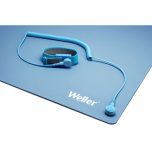 Bench mat + grounding kit
Dissipative mat with snap and ground cord (usually 1 MΩ safety resistor).
View products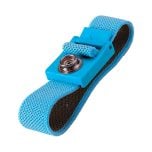 Wrist strap
Connects the person directly to the EBP; test daily or use a continuous monitor.
View products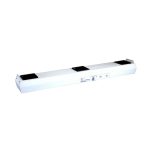

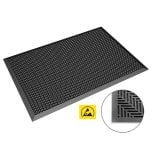 Earth bonding point (EBP)
Central point where all dissipative elements meet in a star topology.
View productsHow do you ground the EPA correctly?
All elements are connected in a star topology to a common earth bonding point (EBP), which is bonded to protective earth (PE). This way no potential differences arise between mat, person and floor.
Ground cords and snaps must be checked for continuity at regular intervals.
How do you test and document the EPA?
Resistances are measured and recorded with an ESD meter and electrodes to IEC 61340‑2‑3. Wrist straps are tested every working day, floors and surfaces periodically.
- Wrist strap: every working day (tester) or continuously (constant monitor).
- Work surface and floor: periodically per the EPA test plan.
- Record results with date, measured value and limit value.
- Ionisers: check discharge time and offset voltage regularly.
Frequently asked questions
Is a wrist strap alone enough?
No. The strap only grounds the standing or seated person at the bench. For movement in the area you also need the system of dissipative footwear and flooring.
Should the flooring be conductive or dissipative?
Dissipative. Purely conductive floors (< 104 Ω) drain charge too fast; the EPA range is 104 to 109 Ω in the person-shoe-floor system.
How often is the EPA tested?
Wrist straps every working day, surfaces and floors periodically per the test plan. All readings are documented with the limit value.
Everything for building your EPA
Mats, wrist straps, floors, ionisers and grounding - compliant with DIN EN 61340-5-1, from a single source.
Standard-compliant
Products and advice to DIN EN 61340-5-1.
Reviewed
Content reviewed by ESD specialists.
Full range
Over 200 brands for the ESD workstation.
Selection help
We help you choose the right products; technical details are clarified with the manufacturer.