
How to Set Up a Two-Bin Kanban at the Workstation
The two-bin kanban supplies small parts at the workstation on a pure consumption basis: when the front bin runs empty it triggers replenishment, while the second bin keeps the line running. This guide shows how to size the bins, choose the replenishment trigger and dimension the flow channels.
To the guidesContents
How does the two-bin kanban work?
In a two-bin kanban, two identical bins holding the same part sit one behind the other in a flow channel. The operator always picks from the front bin. Once it is empty, the bin becomes the signal: it moves to the return point and triggers replenishment, while the second bin slides forward and keeps supply running without interruption.
The empty bin itself is the order card - hence the name kanban (Japanese for card or signal). No slips of paper, no manual stock counts and no software are required. As long as the second bin lasts, replenishment must arrive. That range determines how large the bins have to be.
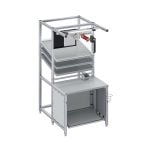 Set up the workstation
How to design the whole assembly station ergonomically and within easy reach.
Read the guideHow do you calculate the right bin size?
A bin must cover consumption over the entire replenishment lead time - from the moment the empty bin triggers to the moment the refilled one returns. The basic formula is: bin quantity = daily usage × lead time in days × safety factor. A safety factor of roughly 1.1 to 1.25 buffers variation in both consumption and delivery time.
- Derive daily usage from real demand, not from the planning figure.
- Measure lead time including picking, transport and refilling.
- Both bins together define the maximum stock at the workstation.
- Check weight: a full bin should stay under about 12 kg for one-handed handling.
Which replenishment trigger suits the line?
The trigger defines how the empty bin leads to replenishment. In its simplest form the empty bin is placed on the return level and collected on the next milk-run loop. A fixed cadence is essential: a tugger train or material runner picks up empties at a defined interval, for example every 30 or 60 minutes.
- Empty-bin return: the bin itself is the signal, ideal for timed milk runs.
- Kanban card on the bin: for a central store or bought-in parts with longer lead time.
- e-kanban by scan or button: an electronic signal for distant suppliers.
- F-kanban (fax/email): for external suppliers with no system link.
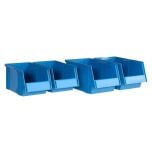
How do you dimension the flow channels?
Flow channels with rollers or wheel rails move the bins on a first-in-first-out basis: pick from the front, refill at the back. The slope is decisive. Too flat and the bin stalls; too steep and it runs down uncontrolled. A gradient of 3 to 5 degrees works well, closer to the upper end for heavy or rough bins.
- Size the channel depth for exactly two bins so no third stock builds up.
- Match bin size, roller pitch and channel width to avoid jamming.
- Fit an end stop and pick guard so the front bin cannot fall out.
- Test the slope angle in practice with a full bin after installation.
Frequently asked questions
Why exactly two bins and not three?
Two bins are the minimum that separates consumption from replenishment: one is emptied, one secures supply. A third would only raise stock and tied-up capital without noticeably improving reliability.
How large should a kanban bin be?
The quantity per bin covers consumption over the full replenishment lead time plus a safety factor of 1.1 to 1.25. Round up to the next standard size and keep the fill weight under about 12 kg for one-handed handling.
What slope does a flow channel need?
Usually 3 to 5 degrees. Light bins run cleanly at 3 degrees; heavy or rough bins need closer to 5. Always test the angle with a full bin after installation.
Does a two-bin kanban need software?
No. In principle the empty bin itself is the order signal. Software (e-kanban) only pays off with many parts, long supply routes or external suppliers without a fixed milk-run cadence.
Setting up a two-bin kanban?
Visual storage bins, live-storage racks and flow rails for timed material replenishment are matched to your bin sizes and cycle times - more in our guides.
Matching bins
Stackable visual storage bins in all standard sizes.
Correctly dimensioned
Flow channels with the right slope and depth.
Paperless
Empty bin as the signal - no slips, no counting.
Selection help
We help you choose the right products; technical details are clarified with the manufacturer.