
ESD Test Records: what an auditor really wants to see
An ESD test record proves that every EPA element stays within the limits. This guide shows which measured values, test instruments and intervals under IEC 61340-5-1 must be documented so the record holds up to an auditor.
View ESD test instrumentsContents
Which measured values must the record contain?
An audit-proof record lists the measured resistance for every EPA element with a clear reference to its limit. Under IEC 61340‑5‑1 the wrist strap plus person system is typically < 1.0 x 10⁹ Ω, dissipative floors need Rg < 1.0 x 10⁹ Ω and a person standing on the floor must stay below that value too.
Each entry needs the actual value in ohms, the required limit and an unambiguous pass or fail. Without the measured number a tick mark is worthless to an auditor because there is nothing to trace back to.
Which instruments and details does the auditor expect?
The auditor checks not only the values but the meter behind them. A resistance meter for ESD work must supply 10 V and 100 V test voltages and carry a valid, traceable calibration.
- Instrument type and serial number of the resistance meter used.
- Calibration date and next due date, traceable to a national standard.
- Test electrode with 2.5 kg contact weight per IEC 61340‑2‑3.
- Test voltage (10 V to 100 V) chosen for the expected resistance range.
- Name or initials of the tester plus date and time.
Which test intervals must be documented?
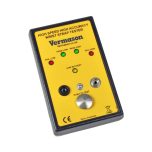
The standard separates the daily personnel test from the periodic EPA verification. Wrist straps are tested every working day before work starts, often through a test station that logs the result automatically.
Ionizers additionally need the offset voltage and discharge time (decay time) recorded. If an interval is exceeded, the gap is visible in the record and the auditor classes the EPA as no longer verified.
How does the documentation stay audit-proof?
Audit-proof means complete, tamper-evident and traceable. Every record needs a date, a tester and an unambiguous result, and all records are kept in order for the required period.
- Retain at least one full verification cycle, usually several years.
- Do not delete a failed measurement, document the corrective action instead.
- On a fail: quarantine the element, log root cause and remedy, record the re-test.
- Digital records with timestamp and write protection against later edits.
Frequently asked questions
How often must a wrist strap be tested?
Every working day before work starts, ideally through a test station with automatic logging. The person plus strap system resistance should stay below 1.0 x 10⁹ Ω.
Does the meter have to be calibrated?
Yes. Without a valid, traceable calibration with date and next due date, the readings are not defensible in an audit. Traceability is part of the record.
Why record temperature and humidity?
Dissipative resistance depends heavily on relative humidity. Only with the climate data is a measurement reproducible and traceable for the auditor.
What happens on a fail result?
The element is quarantined, root cause and remedy are documented and a re-test is logged. The event stays visible, it is not deleted.
Need instruments for audit-proof ESD records?
We supply calibratable resistance meters, test electrodes and wrist strap test stations with limits to IEC 61340-5-1.
Standard-based
Limits and methods per IEC 61340-5-1.
Traceable
Meters with calibrated, documented test chain.
Audit-proof
Continuous evidence across every test interval.
Selection help
We help you choose the right products; technical details are clarified with the manufacturer.