
How do you test ESD protective packaging correctly?
ESD protective packaging only works while its electrical properties stay within limits. This guide shows how to test shielding, surface resistance and resistance to ground per IEC 61340-5-1 and ANSI/ESD S541, which limits apply and how often to verify.
View ESD packagingContents
What must ESD packaging actually achieve?
ESD protective packaging must do three things: dissipate static charge in a controlled way, generate little charge itself, and shield sensitive parts from external discharges. The requirements sit in IEC 61340‑5‑1 (for the EPA) and in the packaging standard ANSI/ESD S541.
Materials are classed as conductive, dissipative or shielding. A shielding bag only acts as a Faraday cage when it is fully closed - sealed or folded and shut, with no gap in the metal layer.
- Conductive: resistance below 1 × 10⁴ Ω, drains charge very fast.
- Dissipative: 1 × 10⁴ to below 1 × 10¹¹ Ω, slower controlled decay.
- Shielding: metallised layer that limits the energy of a discharge reaching the inside.
- Low-charging: generates very little charge itself during handling (low tribo-charging).
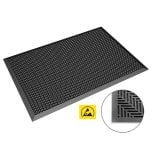
How do you measure surface and ground resistance?
Surface resistance and resistance to ground are measured with a resistance meter and defined electrodes. The method is ANSI/ESD S11.11 for planar materials, or the methods in IEC 61340‑2‑3. Test voltage is 10 V or 100 V depending on the expected resistance range.
Readings depend heavily on humidity, so the sample is conditioned first. ANSI/ESD S541 uses two test atmospheres: a dry worst case at 12 % relative humidity and a moderate one around 50 %. The material is acclimatised for 48 hours before measuring.
How do you test a bag's shielding performance?
Shielding performance is measured to ANSI/ESD STM11.31. The bag sits between two electrodes, a 1000 V discharge pulse is applied, and a probe inside measures the energy that gets through. The bag passes when less than 20 nJ (nanojoules) reaches the inside.
- Visual check first: holes, tears, flaked metallisation or worn edges make any bag unusable.
- Reused bags age - the metallised layer develops micro-cracks and loses shielding.
- Only a fully closed bag shields; an open or merely folded-over bag is not a Faraday cage.
- Tape, labels and view windows must not break the continuous metal layer.
How often should packaging be verified?
IEC 61340‑5‑1 requires a compliance verification plan: defined test equipment, limits and intervals, documented and traceable. For packaging you sample incoming goods and verify reusable bags regularly.
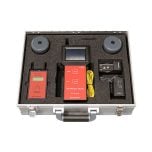
Frequently asked questions
What is the difference between a shielding bag and a dissipative bag?
A shielding bag has a metallised layer and, when closed, forms a Faraday cage that blocks an external discharge (tested to STM11.31, < 20 nJ inside). A dissipative (pink) bag only prevents self-charging and does not shield.
What limits apply to surface resistance?
Under ANSI/ESD S541 a surface is conductive below 1 × 10⁴ Ω and dissipative from 1 × 10⁴ to below 1 × 10¹¹ Ω. Measurement follows S11.11 under a controlled climate.
Why test at 12 % humidity?
12 % relative humidity is the dry worst case, as in winter with heated indoor air. Dry air lowers dissipation, so the packaging must still stay within limits there.
How often must reusable bags be tested?
The 61340‑5‑1 verification plan sets the interval. Typical practice is periodic sampling plus a visual check before every reuse; damaged bags are removed from service.
Need to test or source ESD packaging?
We supply tested shielding, dissipative and conductive packaging plus meters for verification to IEC 61340-5-1 and ANSI/ESD S541.
Standards-tested
Materials to IEC 61340-5-1 and ANSI/ESD S541.
Measurably safe
Resistance and shielding documented and verifiable.
Defined test climate
Conditioning at 12 % and 50 % relative humidity.
Selection help
We help you choose the right products; technical details are clarified with the manufacturer.