
Point-to-point or resistance-to-ground - which test?
Point-to-point resistance (Rp2p) and resistance-to-ground (Rg) check different properties of an ESD element. This guide shows which method IEC 61340-2-3 calls for on table mats, flooring, wrist straps and chairs, which test voltage applies and which limits you must meet.
View ESD test equipmentHow do Rp2p and Rg differ?
Point-to-point resistance Rp2p measures the resistance between two points on the same surface, while resistance-to-ground Rg measures from one point to the common ground point. Both describe an ESD element but answer different questions: Rp2p checks how uniform the surface is, Rg checks the connection to earth.
A surface can be uniformly dissipative (good Rp2p) yet poorly grounded (high Rg), for example with a loose snap connection or a broken ground cord. Only both measurements together confirm that a charge really drains to earth in a controlled way.
- Rp2p: two 2.5 kg electrodes at a defined spacing on the surface.
- Rg: one electrode on the surface, the second lead at the ground point.
- Rtt (point-to-point on the same item) is a variant of Rp2p.
10 V or 100 V - which test voltage?
The test voltage follows the expected resistance. Per IEC 61340‑2‑3 you measure first at 10 V; if the reading exceeds 10⁶ Ω, you repeat at 100 V. This keeps the measuring current in a sensible range so the values stay comparable.
Surface electrodes weigh 2.5 kg each and carry a defined conductive rubber contact face. This weight ensures repeatable contact, so measurements taken on different days remain comparable.
Which test for which ESD element?
Each ESD element has a sensible combination of Rp2p and Rg. Table mats and floors are measured in both modes, while wrist straps are tested as a complete system of person plus strap to ground.
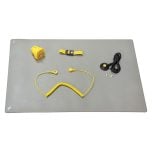
- Table mat: Rp2p confirms a uniform surface, Rg the earthing via the 1 MΩ cord.
- Flooring: several test points, because seams and adhesive change the value.
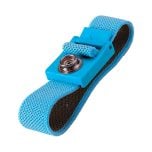
- Wrist strap: test as a system with the person, not the strap alone.
- Chair: Rg is measured through the conductive castors to the floor.
How do you measure reliably and on record?
A reproducible result needs clean contact, the right climate and a calibrated meter. Clean the surface first, wait a few seconds until the reading settles, then note the voltage, climate and test point.
- Have the meter calibrated yearly and keep the certificate.
- Keep electrodes clean, dirty contact faces distort the reading.
- If a limit is exceeded, check the ground cord, the snap and the cleaning.
Frequently asked questions
When do I measure Rp2p and when Rg?
Rp2p checks how uniform a surface is, Rg its connection to earth. For mats and floors you measure both, for wrist straps you measure the system of person plus strap to ground.
Why 10 V first, then 100 V?
IEC 61340‑2‑3 starts the measurement at 10 V. If the resistance exceeds 10⁶ Ω, you repeat at 100 V so the measuring current fits and the readings stay comparable.
Why do the electrodes weigh 2.5 kg?
The defined weight gives a constant contact pressure on the surface. Only then are measurements reproducible on different days and in different places.
In which climate is testing done?
Dissipative materials are tested in the worst-case, dry climate at low humidity, because resistance is highest and therefore most critical there.
Looking for the right ESD test equipment?
We supply resistance meters, 2.5 kg electrodes and test kits for Rp2p and Rg - built to IEC 61340-2-3 and EN 61340-5-1.
Standard-compliant
Test setups to IEC 61340-2-3 and 61340-5-1.
Reproducible
Calibrated meters and 2.5 kg standard electrodes.
On record
Test logs for audit and proof of compliance.
Selection help
We help you choose the right products; technical details are clarified with the manufacturer.