Laser Level vs Spirit Level - Which Is More Accurate?
A laser level projects an exact reference line across several metres, while a classic spirit level only measures where the tool rests. This guide compares accuracy in mm/m, self-levelling, range and laser class to show which tool fits workshop assembly.
View measuring toolsHow do laser and spirit level differ in principle?
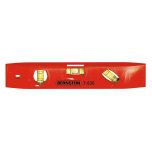
The classic spirit level uses a vial: a curved glass tube with liquid and an air bubble that is centred between two marks. It measures the inclination exactly where the tool rests. A laser level instead creates a visible light line or point that projects the reference plane freely into the room across several metres.
This solves the core limitation of the spirit level, which only works up to its own length of usually 40 to 200 cm. For a continuous line across a whole workbench or wall you would have to reposition the level repeatedly, adding a small error at every step.
How accurate are laser and spirit level really?
Accuracy for both is stated in mm per metre. A good workshop spirit level sits at about 0.5 mm/m, premium models reach 0.3 mm/m. Solid cross-line lasers manage 0.2 to 0.3 mm/m, precision units go down to 0.1 mm/m.
Over short distances the difference is small: at 40 cm, 0.5 mm/m means only 0.2 mm of deviation. Across 5 m of wall, however, the same tolerance adds up to 2.5 mm, while the laser holds the line continuously without repositioning errors.
- Always compare accuracy as mm/m, never as a percentage.
- Before buying, turn the spirit level against a checked reference and verify it reversed.
- Have the laser recalibrated periodically against a known horizontal.
- Over long distances range matters more than the last tenth of a mm/m.
What does self-levelling offer and how much range is enough?
Self-levelling lasers align themselves automatically to horizontal and vertical within a catch range of about ±3 to ±4°. A pendulum-mounted prism or an electronic sensor handles the alignment, so a slightly uneven surface does not cause a false reading.
For the workshop a cross-line laser of laser class 2 (red or green, under 1 mW) is usually enough and may be used without safety glasses. Green lines appear much brighter to the eye and are worth it in bright ambient light.
- A catch range of ±3 to ±4° covers normal floors and benches.
- A lockable pendulum lock protects the prism during transport.
- Green laser in daylight, red laser as an affordable workshop option.
- A 1/4 inch tripod thread or magnetic mount for hands-free assembly.
Frequently asked questions
Is a laser level more accurate than a spirit level?
Over short distances both are comparable. The laser level shows its strength on long lines, because it measures continuously across several metres without repositioning and so avoids cumulative errors.
What does self-levelling mean?
The device aligns itself automatically to horizontal within a catch range of about ±4°. A pendulum or sensor handles this, and a blinking line warns you when the tool is outside the range.
Which laser class makes sense for the workshop?
Class 2 with under 1 mW output is common for visible light and may be used without safety glasses. A brief glance is harmless, but staring directly into the beam should still be avoided.
Red or green - which laser colour?
Green lines appear up to four times brighter to the eye and are better visible in daylight. Red lasers are cheaper and usually sufficient in enclosed workshops.
Looking for the right measuring tool?
We supply line lasers, cross-line lasers and checked spirit levels for workshop assembly - with accuracy stated in mm/m and matching accessories.
Clear accuracy
Every tool states its tolerance in mm/m.
Self-levelling
Models with catch range and pendulum lock.
Safe laser class
Workshop lasers of class 2 under 1 mW.
Selection help
We help you choose the right products; technical details are clarified with the manufacturer.