
How to choose a socket ratchet set for your workshop
A good socket set depends on the right drive size, a fine-tooth ratchet and the matching socket profile. This guide explains when to use 1/4, 3/8 or 1/2 inch, what tooth count means and why 6-point often grips better than 12-point.
View socket setsWhich drive size do you need?
The drive size is the square that connects ratchet and socket. The common ones are 1/4 inch (6.3 mm), 3/8 inch (10 mm) and 1/2 inch (12.7 mm). A larger drive transmits more torque but makes the tool bulkier in tight spots.
For electronics, bicycles and fine assembly, 1/4 inch is enough. 3/8 inch is the all-rounder for car and motorcycle work, while 1/2 inch handles suspension, wheel nuts and anything high-torque. If you only buy one set, 3/8 inch is the most flexible choice.
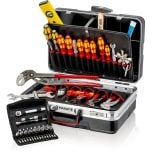
What does the ratchet tooth count mean?
The tooth count is how many locking points the ratchet head has per revolution. From it comes the swing arc: the smallest angle you have to swing the ratchet back before it engages again. A smaller angle means you can work in tighter spaces.
- 36 teeth: 10° swing arc, robust and cheap for rough work.
- 72 teeth: 5° swing arc, the proven workshop standard.
- 90 teeth: 4° swing arc, ideal on very tight fasteners.
- A reversing lever for quick direction changes is a must.
- Fine-tooth heads take less shock load - never overload them with a cheater bar.
Also check for a clean reversing lever, a ball detent or quick-release for the sockets and an ergonomic handle. A good ratchet engages with a distinct click and no play.
6-point or 12-point socket?
The internal profile decides how force hits the fastener head. 6-point grips the flats of the bolt and transmits high torque safely. 12-point has twice as many engagement points and fits every 30°, which is handier but more delicate.
- Use deep sockets for threaded studs that stick out.
- Chrome-vanadium steel is standard for hand sockets, chrome-molybdenum for impact sockets.
- Never replace impact sockets (black, thick-walled) with chromed hand sockets.
Frequently asked questions
Which drive size is best to start with?
For a single universal set, 3/8 inch is the best choice. It covers the widest range of car and assembly work and is neither too coarse nor too weak.
How many teeth should a good ratchet have?
72 teeth with a 5° swing arc is the proven standard. 90 teeth help in very tight spots but are mechanically more sensitive to shock and overload.
When do I use 6-point versus 12-point?
6-point transmits more force and rounds off stuck bolts less often. 12-point engages faster and suits accessible standard fasteners.
Can I use hand sockets with an impact wrench?
No. Chromed hand sockets can shatter. Impact wrenches need thick-walled, phosphated impact sockets made of chrome-molybdenum steel.
Looking for the right socket set?
We stock sets in 1/4, 3/8 and 1/2 inch with fine-tooth ratchets plus 6-point and 12-point sockets in chrome-vanadium steel.
Proven quality
Sockets and ratchets in hardened chrome-vanadium steel.
All drives
1/4, 3/8 and 1/2 inch from one source.
Perfect fit
6-point and 12-point for every fastener.
Selection help
We help you choose the right products; technical details are clarified with the manufacturer.