
Planning LED Workshop Lighting - What Matters Most?
Good light drives precision, speed and comfort at every workbench. This guide shows how to plan LED workshop lighting by luminous flux, colour rendering (CRI) and glare-free layout for fine detail work - based on EN 12464-1.
View workshop lightingHow much light does a workshop really need?
What counts is not wattage but luminous flux in lumens and the resulting illuminance in lux at the work surface. EN 12464‑1 recommends 300 to 500 lx for general workshop work, 500 to 750 lx for assembly and inspection, and 750 to 1000 lx or more for fine, precise detail work.
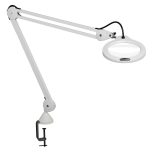
Illuminance falls with the square of the distance. A luminaire rated 4000 lm mounted at 2 m delivers far fewer lux on the bench than the same output used as a task light at 40 cm. Plan a combination of even ambient lighting and focused task lighting at each station.
Why is colour rendering (CRI) so decisive?
The colour rendering index CRI (Ra) describes how natural colours look under a lamp, from 0 to 100. For detail work, reading cable colours, judging solder joints or spotting material flaws, CRI ≥ 90 is the target; cheap LEDs at CRI 80 make reds and skin tones look dull and hinder fault finding.
Light colour is stated as colour temperature in Kelvin. Neutral white around 4000 K is the proven workshop standard: it looks businesslike, tires the eyes less than cold light and renders colours neutrally. 3000 K feels warm and cosy, while above 5000 K the light turns clinical and can strain the eyes during long detail work.
- CRI ≥ 80: minimum for indoor workplaces under EN 12464‑1.
- CRI ≥ 90: recommended for detail work, electronics, quality inspection and colour matching.
- 3000 K warm white: break areas, reception, ancillary rooms.
- 4000 K neutral white: the standard for workshop and assembly.
- 5000‑6500 K daylight white: only for the highest contrast demands.
How do you arrange luminaires glare-free?
Glare lowers visual performance and tires the eyes. The UGR value (Unified Glare Rating) rates discomfort glare; for detail work and screen stations UGR ≤ 19 applies. Low-glare luminaires with micro-prismatic or louvre covers and a shallow beam angle keep within the limit.
Position luminaires so light arrives from the side or at an angle from the front and hands cast no hard shadow on the workpiece. Spotlights mounted directly overhead create shadows and reflections on glossy parts; wide linear or panel luminaires give soft, low-shadow light.
- Low-glare optics (micro-prism, louvre) instead of bare LED strips.
- Task light offset to the side, not head-on in the line of sight.
- Avoid reflections on glossy surfaces by using wide luminaires.
- Choose flicker-free drivers - vital with cameras, microscopes and video.
Frequently asked questions
How many lux do I need for fine detail work?
For fine assembly, soldering and inspection, EN 12464‑1 recommends at least 750 to 1000 lx on the work surface, often topped up with a dedicated task light right at the workpiece.
Which colour temperature is best for a workshop?
Neutral white around 4000 K is the proven choice: it renders colours neutrally, tires the eyes less than cold-white light and suits assembly, inspection and detail work alike.
Why is CRI 90 better than CRI 80?
A CRI of 90 or higher renders colours far more naturally. Cable colours, solder joints, material flaws and skin tones are easier to read, which cuts errors. CRI 80 makes reds in particular look dull.
How do I avoid glare at the bench?
Use low-glare luminaires with UGR ≤ 19, position them to the side or at an angle from the front, and keep bare LED strips out of the line of sight while avoiding reflections on glossy surfaces.
Looking for LED workshop lighting?
We supply flicker-free LED luminaires with high CRI and low-glare optics for assembly, inspection and detail work - in line with EN 12464-1.
High colour fidelity
Luminaires with CRI ≥ 90 for precise colour recognition.
Glare-free by design
Low-glare optics with UGR ≤ 19 for comfortable vision.
Flicker-free
Quality drivers with no disturbing stroboscopic effect.
Selection help
We help you choose the right products; technical details are clarified with the manufacturer.