
Sample-based stocktaking: count less, stay compliant?
Sample-based stocktaking replaces a full physical count with a statistically valid extrapolation. This guide explains the legal basis, the required 95 % confidence at a maximum 1 % relative error and how to determine the sample size you actually need.
View storage systemsContents
What is sample-based stocktaking and when is it allowed?
In sample-based stocktaking only a randomly selected share of stock positions is physically counted. A recognised statistical procedure then extrapolates the total inventory value from that sample. Under recognised accounting principles the method is permitted as long as its evidential value matches a full physical count.
For that equivalence the standards require a confidence level of at least 95 % at a relative sampling error of no more than 1 % of the total value. If both limits are met, the extrapolated valuation is treated as equal to a complete count for balance sheet purposes.
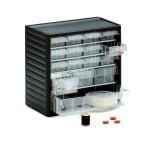 Storage systems
Clear bin locations and labelling are the basis of every auditable count.
View productsWhich extrapolation methods exist?
Two approaches dominate in practice: free extrapolation (mean estimation) and difference estimation. Which one fits depends on how well the book quantities match physical reality.
Difference estimation is the most common approach because it uses the existing book values: only the deviation between target and actual is counted. As these differences usually vary little, far smaller samples suffice than with free extrapolation.
- Stratify the population sensibly (e.g. by A/B/C value classes).
- Count high-value items (A parts) fully, sample the rest.
- Screen out zero balances and extreme values in advance.
- Draw the random selection by software, not by intuition.
How large does the sample need to be?
The sample size follows mathematically from the required confidence (95 %), the permitted error (1 %) and the spread of stock values. The more homogeneous the warehouse, the smaller the sample. In practice only 5 to 15 % of positions are actually counted.
Crucially, the absolute sample size grows less than proportionally as the warehouse gets bigger. That is exactly why the method pays off most in large small-parts stores with many low-value positions. If the extrapolation breaches the 1 % limit, the sample must be enlarged or the method changed.
What do auditors look for in the implementation?
For the auditor to accept sample-based stocktaking, the procedure must be documented transparently. The decisive points are a clean random selection, a recognised estimation method and proof that the error limits were kept.
- Description of the chosen extrapolation method.
- Proof of random selection including a drawing protocol.
- Calculated relative error and confidence level.
- Target/actual reconciliation for every counted position.
- Documentation of stratification and full-count classes.
Frequently asked questions
Is sample-based stocktaking legally permitted?
Yes. Recognised accounting principles allow mathematical-statistical methods as long as their evidential value matches a full physical count, i.e. 95 % confidence at no more than 1 % relative error.
How much counting effort does it save?
Depending on homogeneity and the quality of book quantities, 80 to 95 % of count positions can be saved. Large small-parts warehouses benefit most because the sample size grows less than proportionally.
What does the 1 % limit mean?
The total value extrapolated from the sample may deviate from the true value by at most 1 % with 95 % probability. If the limit is exceeded, the sample must be enlarged.
Which stock is unsuitable?
Very heterogeneous or especially high-value positions (A parts) are usually counted in full. Sampling is unsuitable for them; they form a separate stratum with a complete count.
Preparing your warehouse for sample stocktaking?
Clear bin locations, labelling and orderly small-parts storage are the basis of an auditable extrapolation - we supply the matching storage systems.
Compliant method
Procedure aligned with recognised accounting principles.
Statistically sound
95 % confidence at a maximum 1 % error.
Less effort
Up to 95 % fewer count positions.
Audit-proof
Traceable documentation for the annual accounts.