
Choosing an Assortment Case - Which Fits Your Small Parts?
An assortment case with adjustable dividers brings screws, standard parts and small components into a clear order. This guide shows how to pick compartment sizes and dividers, build a colour system with organising colours and decide between mobile and stationary use.
View assortment casesContents
How is an assortment case with dividers built?
An assortment case consists of a shallow tray, a transparent lid and a grid of fixed and insertable dividers. The adjustable partitions let you split the interior freely into small and large compartments, so every part size gets a tidy home.
A grid in the base defines the possible divider positions. Fixed lengthwise partitions stay in place, while short cross dividers can be repositioned in seconds. That way the case adapts when the assortment changes.
- Tray of impact-resistant polypropylene (PP), resistant to oil and many solvents.
- Fixed lengthwise partitions as a base grid, short cross dividers freely movable.
- Transparent lid for a quick overview without opening.
- Stackable outer shape or one that slides into a rack.
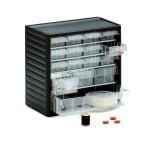 Plan a small-parts store
How to set up shelving, bins and assortment cases as one system.
View productsWhich compartment sizes and dividers do you need?
The key factors are the number of compartments, the compartment depth and the flexibility of the dividers. Small standard parts such as M3 screws, washers or SMD accessories need many small compartments, while bulky parts need a few large ones. A variable grid covers both cases in one box.
- Match the compartment depth to the largest batch so the lid still closes flush.
- Dividers should sit firmly and not jump out under vibration.
- Store standard parts by DIN/ISO reference separately to avoid mix-ups.
How do organising colours help with sorting?
Organising colours turn many identical cases into a system. When each part type or area gets a fixed colour, you spot the right case from a distance. That saves search time and reduces picking errors during assembly.
- Red for safety or consumable parts that need frequent replenishment.
- Blue for standard parts such as screws and nuts.
- Green for inspected or released assemblies.
- Yellow for test equipment and special parts.
- Same colour for the case and its shelf slot so return storage stays unambiguous.
Mobile or stationary - which is better?
The choice depends on whether the parts come to the person or the person goes to the parts. A carried case relies on a firm lid latch and a handle, a fixed storage slot relies on stackability and a consistent grid dimension.
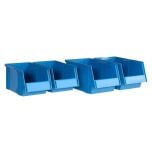 Open-front bins
For open access on the shelf, storage bins complement the closed assortment case.
View productsFrequently asked questions
What material are good assortment cases made of?
Usually impact-resistant polypropylene (PP). It is break-proof, resistant to oil and many solvents and easy to clean. For ESD areas there are conductive versions.
How fine should the divider grid be?
Pick a grid one step finer than you currently need. That lets you form smaller compartments later without buying a new case. For M3-M8 screws, 12 to 24 compartments are common.
Is a colour system worth it with only a few cases?
Yes, from around ten cases a fixed colour assignment clearly saves search time. Always combine the colour with a label that names the exact contents and the standard reference.
Can I use the same case mobile and stationary?
Yes, if it has a uniform outer dimension such as A4 or A5 and a tight lid latch. Then it fits the service kit and the shelf without breaking the organising system.
Looking for the right assortment case?
We supply assortment cases with adjustable dividers, in several organising colours and in uniform outer dimensions for mobile and stationary use.
Rugged material
Impact-resistant polypropylene, oil and solvent resistant.
Colour systems
Several organising colours for clear assignment.
Uniform sizes
A4 and A5 grids for shelf and service kit.
Selection help
We help you choose the right products; technical details are clarified with the manufacturer.