
Soldering defects: how to spot and prevent them
Cold joints, tombstoning, bridges and voids are the most common soldering defects in electronics assembly. This guide shows how to identify each one, what really causes it, and how to prevent it through temperature, flux and pad design.
View soldering productsWhat soldering defects exist and how do you spot them?
Most soldering defects can be identified by eye or under a loupe from the shape and shine of the joint. A good joint is bright, smooth and wets both pad and lead with a clean concave fillet at less than 90 degrees.
A cold joint looks dull, grainy or cracked because the solder never fully melted. Tombstoning lifts a chip component upright on one end like a headstone. Solder bridges connect two pads by accident, and voids are trapped gas pockets inside the joint.
What causes the typical soldering defects?
Almost every defect traces back to poor heat control, spent flux or an unbalanced pad layout. Once you know the root cause you fix the problem instead of just reworking the joint.
- Cold joint: temperature too low, dwell time too short or movement during solidification.
- Tombstoning: uneven heating of the two pads, so one end wets first and pulls the part upright.
- Solder bridge: too much solder, a dirty tip or pad spacing that is too tight.
- Void: trapped flux gases, moisture inside the component or a reflow profile that ramps too fast.
- Non-wetting: an oxide layer on the pad or lead, or missing and exhausted flux.
How do you reliably prevent soldering defects?
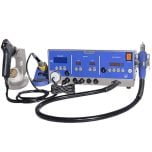
The most effective prevention is a controlled process chain: clean surfaces, the right flux, a temperature-regulated station and a tip with good heat transfer. Together these all but eliminate cold joints, bridges and tombstones.
- Clean pads and leads before soldering and use oxide-free surfaces.
- Keep the tip tinned and wipe it regularly on a dry or damp cleaner.
- Set the temperature to 320‑360 °C and limit dwell time to 1‑3 seconds per joint.
- For chip components, ensure symmetrical pads and even heating to avoid tombstoning.
- Bake moisture-sensitive (MSL) parts before reflow to prevent voids and the popcorn effect.
Frequently asked questions
How do I recognise a cold joint?
A cold joint is dull, grainy or cracked instead of smooth and shiny. It comes from too little heat or movement during solidification and often causes intermittent contact.
What causes tombstoning?
When the two pads of a chip part heat up unequally, one side wets first and lifts the part vertically. Symmetrical pad design and even heating prevent it.
How do I remove a solder bridge?
Lift the excess solder with desoldering braid or a clean, well-tinned tip and apply fresh flux. The usual causes are too much solder or a contaminated tip.
Are voids always a defect?
Small voids are allowed within limits under IPC-A-610. Only larger or clustered voids reduce mechanical and thermal strength and must be assessed.
Fewer soldering defects on your line?
We supply temperature-regulated stations, matching tips, flux and inspection aids - for clean joints that meet IPC-A-610.
Regulated temperature
Stations with stable tip temperature for reproducible results.
IPC verified
Acceptance criteria per IPC-A-610 as a clear quality benchmark.
Right alloy
Lead-free and leaded solders plus flux for every application.
Selection help
We help you choose the right products; technical details are clarified with the manufacturer.