
How to set the right soldering temperature
The correct soldering temperature decides whether joints are clean and how long your tip lasts. This guide gives concrete values for lead-free and leaded solder, explains the influence of tip shape and thermal mass, and shows how to recognise too hot and too cold.
View soldering stationsWhat temperature for lead-free and leaded?
Soldering temperature is set from the alloy melting point plus a margin for heat transfer. Leaded solder (Sn60Pb40 / Sn63Pb37) melts at around 183 °C, while lead-free solder (SAC305, Sn96.5Ag3Cu0.5) only melts near 217‑220 °C. That is why the tip temperature always sits well above the melting point.
As a rule of thumb, use 280‑300 °C tip temperature for leaded solder and 300‑320 °C for lead-free. Large ground planes or heavy leads may need a brief increase, while fine SMD parts call for slightly lower settings.
Why do tip shape and mass matter more than degrees?
It is not the number you dial in that counts, but how much heat actually reaches the joint. What matters is the contact area and thermal mass of the tip. A larger chisel tip transfers far more energy at the same temperature than a fine pencil tip.
- Chisel and hoof shapes: large contact area, ideal for fast heat transfer and ground pins.
- Conical tip: fine and precise, but little thermal mass for small pads.
- Always choose the largest tip that still fits the joint.
- A small drop of solder on the tip (heat bridge) noticeably improves thermal contact.
- Cold, oxidised tips conduct poorly - re-tin them regularly.
How do I recognise too hot or too cold?
A good joint is shiny, concave and wets both pad and lead completely. Deviations reveal an unbalanced heat budget. Both too hot and too cold produce unreliable connections.
Soldering too cold produces dull, balled joints without proper wetting - the classic cold joint with microcracks. Soldering too hot chars the flux, lifts pads (lift-off) and damages temperature-sensitive parts. The goal is a short wetting time of under three seconds at moderate temperature.
Frequently asked questions
What is the right temperature for lead-free solder?
SAC305 melts at about 217‑220 °C, and the tip is usually set to 300‑320 °C. Go slightly higher for large ground planes and lower for fine SMD parts.
Can I solder faster with a very high temperature?
No. A higher temperature barely shortens the wetting time but chars the flux, damages parts and wears the tip quickly. More heat comes from a larger tip, not a higher degree setting.
Why are my joints dull and grainy?
Dull, grainy joints point to too little heat or movement during solidification. Check tip size, heat bridge and contact time before you raise the temperature.
Do I need to change temperature between leaded and lead-free?
Yes. Lead-free needs about 20 °C more than leaded because of its higher melting point. Adjust the tip temperature and freshly re-tin the tip when switching.
Looking for the right soldering station?
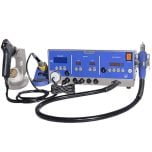
We supply temperature-controlled soldering stations with matching tips for lead-free and leaded work - precise and ESD-safe.
Precisely controlled
Stable tip temperature for reproducible joints.
Matching tips
A wide range of shapes for every application.
ESD-safe
Dissipative stations protect sensitive components.
Selection help
We help you choose the right products; technical details are clarified with the manufacturer.