
Equipped Tool Case - What Basic Kit Do You Need?
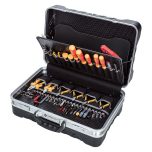
An equipped tool case brings the basic kit for service and assembly straight to the job. This guide shows which tools really belong inside, how inlays keep everything in order and how to recognise a rugged build.
View tool casesWhat belongs in the basic kit?
A sensible basic kit covers the most common tasks in service and assembly without overloading the case. The core is screwdriving tools, pliers, a socket set and measuring gear, rounded out by test and consumable items.
Stick to one consistent drive system: a ratchet set with 1/4 inch for fine work and 1/2 inch for higher torque covers almost every fastener. Bits in slotted, PH, PZ, Torx and hex profiles often make a separate screwdriver set unnecessary.
- Screwdriver set in slotted, cross (PH/PZ) and Torx, plus a bit ratchet handle.
- Pliers: combination pliers, side cutters, needle-nose pliers and water-pump pliers.
- Socket set in 1/4" and 1/2" with ratchet, extension and sockets 4‑24 mm.
- Combination spanner set 8‑19 mm and a set of hex (Allen) keys.
- Measuring and testing: tape measure, spirit level, voltage tester and a multimeter.
- Small parts: insulating tape, cable ties, an assortment of screws and a utility knife.
How do inlays keep it in order for good?
Order decides speed and completeness. A precisely cut inlay gives every tool a fixed home, so a missing piece is spotted at once and nothing rattles inside the case.
Cut foam trays with a routed outline suit fixed tool sets, because an empty recess makes the visual check easy. Pick-and-pluck foam is ideal when you build up the case yourself. In the lid, elastic loops and pockets hold flat or frequently changing items.
How do you spot a rugged build?
In service use, the durability of the case matters. An impact-resistant shell, sturdy hinges and reinforced corners decide how long a case survives transport and the job site.
- Shell in impact-resistant plastic (PP or ABS) or aluminium with a frame profile.
- Metal-reinforced corners and solid latches with a seal-lock eyelet.
- A perimeter gasket and IP rating for wet and dusty outdoor conditions.
- Ergonomic carry handle; on trolley cases a telescopic handle and wheels.
- Swappable inlays so the case can be re-equipped for years.
Frequently asked questions
How many pieces should a tool case have?
For service and assembly, 40 to 120 pieces is practical. More important than the count is that the most common screwdriving, plier and measuring tasks are fully covered.
Plastic or aluminium?
Plastic cases in PP or ABS are light and impact-resistant, aluminium cases feel more premium and hold their shape but weigh more. For a lot of transport, plastic is usually the more practical choice.
What does a cut foam inlay offer?
It gives every tool a fixed outline. If a piece is missing, the empty recess is seen at once, which confirms completeness before the job and prevents rattling.
Do I need an ESD case?
For work on electronic assemblies, yes. Dissipative inlays and ESD tools prevent static discharges from damaging sensitive components.
Looking for the right tool case?
We supply equipped and empty tool cases with precisely fitted inlays - rugged for service, assembly and the workshop.
Sensibly equipped
Basic kit without ballast for service and assembly.
Always complete
Fitted inlays reveal a missing tool at once.
Built rugged
Impact-resistant shells and reinforced corners.
Selection help
We help you choose the right products; technical details are clarified with the manufacturer.