
Pressure switch or pressure sensor - which one when?
A pressure switch gives a switching signal (on/off) at a set point with hysteresis. A pressure sensor or transmitter gives a continuous signal proportional to pressure - analog as 4-20 mA or 0-10 V, or digital via IO-Link. The choice depends on whether one switch point is enough or the pressure has to be measured.
View pressure switches & sensorsWhat is the difference between a pressure switch and a pressure sensor?
A pressure switch monitors a pressure and gives a switching output (on/off) as soon as a set point is reached - mechanically via a diaphragm and spring, or electronically. A pressure sensor or transmitter measures the pressure continuously and gives a continuous signal proportional to pressure. The switch answers "pressure reached - yes or no?", the sensor answers "exactly how high is the pressure?".
| Feature | Pressure switch | Pressure sensor / transmitter |
|---|---|---|
| Output | switching signal on/off | continuous 4-20 mA, 0-10 V, IO-Link |
| Use | monitor a limit, switch | measure, display, control |
| Accuracy | switch point with hysteresis | measured value across the range |
How do set point and hysteresis work?
The set point (switch point) is the pressure at which the switch operates. The hysteresis is the difference between the switch-on and switch-back point: it stops the output chattering around the set point on small pressure fluctuations. On electronic switches both are usually freely adjustable.
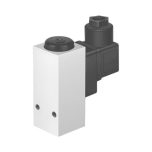 Set point (switch point)
Pressure at which the output switches - choose to match the application.
View
When a switch, when a sensor - which one when?
A pressure switch is enough when only a limit is monitored - pump on/off, enable only above a minimum pressure, or signal a clogged filter. A pressure sensor is needed when the pressure has to be displayed, logged or controlled, or when a controller needs the measured value.
| Task | Recommendation | Signal |
|---|---|---|
| monitor a limit, switch | pressure switch | on/off |
| display and control pressure | pressure sensor | 4-20 mA / 0-10 V |
| values to controller / PLC | sensor with IO-Link | digital IO-Link |
On accuracy: a pressure switch is only as accurate as its switch point plus hysteresis - it does not measure the value. A pressure sensor outputs the measured value across the whole range; its accuracy depends on the sensor. Clean, prepared air protects both - see Air preparation.
Frequently asked questions
What is the difference between a pressure switch and a pressure sensor?
A pressure switch gives a switching signal on/off at a set point. A pressure sensor measures the pressure continuously and gives a continuous signal, for example 4‑20 mA, 0‑10 V or IO-Link.
What does hysteresis mean on a pressure switch?
Hysteresis is the difference between the switch-on and switch-back point. It prevents the output from switching on and off repeatedly on small pressure fluctuations around the set point.
When is a pressure switch enough and when do I need a sensor?
A pressure switch is enough when only a limit is switched. A pressure sensor is needed when the pressure has to be measured, displayed, logged or controlled.
The right pressure switch or pressure sensor
Pressure switch with a switching output or pressure sensor with analog and IO-Link signal - matched to your application.
Explained factually
Switching and measuring principle set out side by side.
Reviewed
Content reviewed by pneumatics specialists.
Full range
Pressure switches, sensors and accessories from one source.
Selection help
We help you choose the right products; technical details are clarified with the manufacturer.