
Workplace lighting: how much lux, which colour temperature?
Good workplace light means enough lux for the visual task, a neutral-white colour temperature around 4000 K, limited glare and high colour rendering. EN 12464-1 gives a maintained value for each task - rough work needs less, fine assembly and inspection clearly more.
View workplace luminairesHow much lux does a workplace need?
The required illuminance depends on the visual task: the finer the detail and the higher the accuracy, the more lux. EN 12464‑1 sets a maintained value for each task - the value the lighting must not fall below over its service life, not the value when new.
| Visual task | Example | Illuminance |
|---|---|---|
| Rough work | storage, picking, coarse assembly | 300 lx |
| Normal visual tasks | assembly, medium bench work | 500 lx |
| Fine work | fine assembly, electronics, inspection | 750-1000 lx |
| Precision work | very fine inspection, micro-assembly | 1000 lx and more |
Which colour temperature and colour rendering are right?
For focused work, neutral-white light around 4000 K has proven itself: matter-of-fact, without the warm yellow tint of low colour temperatures and without the cool harshness of very high ones. Colour rendering (Ra or CRI) matters just as much - how natural colours appear under the light.
| Metric | Meaning | Recommendation for workplace |
|---|---|---|
| Colour temperature | light colour from warm to cool | neutral white, ~4000 K |
| Colour rendering Ra/CRI | natural colour recognition | Ra ≥ 80, higher for inspection |
| Warm white | below 3300 K, cosy | breaks, not fine work |
| Daylight white | above 5300 K, cool | inspection, colour matching |
How are glare and shadows avoided?
Luminaires that are too bright or badly placed cause glare and fatigue - EN 12464‑1 limits this through the UGR value (Unified Glare Rating). The finer the task, the lower the permissible UGR. Hard cast shadows likewise obscure the view of fine detail.
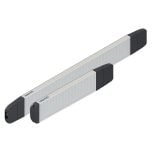 Limit glare (UGR)
Low-glare luminaires and correct positioning keep the UGR within the permissible range - the finer the task, the lower.
View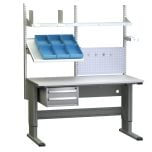 Shadow-free light
Several light sources or wide-area luminaires avoid hard cast shadows on the workpiece.
View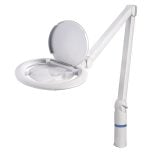 Magnifier lamps
For fine work, LED magnifier lamps combine high illuminance at the workpiece with magnification.
View productsLighting is part of the overall ergonomic picture - see Choosing a workbench and Workplace ergonomics.
Frequently asked questions
How much lux does a workplace for electronics need?
For fine assembly, electronics and inspection, EN 12464‑1 typically gives 750 to 1000 lx, and more for very fine tasks. Normal assembly work manages with around 500 lx and rough tasks with about 300 lx.
Which colour temperature is ideal at the workplace?
For focused work, neutral-white light around 4000 K is common. Warm white below 3300 K feels cosy but is less activating; daylight white above 5300 K suits inspection and colour-matching tasks.
What does the UGR value mean?
UGR (Unified Glare Rating) describes the psychological glare from a lighting installation. EN 12464‑1 sets an upper limit per visual task - the finer the task, the lower the permissible UGR. Low-glare luminaires help to keep within it.
The right lighting for your workplace
LED workplace luminaires and magnifier lamps with neutral-white light and high colour rendering - compliant with EN 12464-1.
Standard-compliant
Values to EN 12464-1.
Reviewed
Content reviewed by workplace specialists.
Full range
Workplace and magnifier lamps.
Selection help
We help you choose the right products; technical details are clarified with the manufacturer.