
How does air ionisation neutralise static charge on insulators?
Insulators cannot be grounded, so their charge stays put without a countermeasure. An ioniser uses corona discharge to create balanced positive and negative ions in the air. These ions drift to the charged surface and neutralise it. The key metrics are offset voltage and decay time.
View ionisersWhy do insulators need an ioniser?
Because an insulator cannot drain its charge through a ground path. Plastic housings, films, tapes and PCB carriers are not dissipative. Only moving air ions reach the surface and balance the charge - which is exactly what an ioniser delivers.
Grounding measures such as wrist straps, ESD flooring and table mats only protect conductive and dissipative items. A charged insulator remains a field source even inside a perfectly grounded EPA and can damage sensitive components through induction.
In corona discharge, a high voltage is applied to fine emitter points. It ionises the surrounding air and produces both polarities. The charged surface attracts the ions of the opposite polarity until the residual charge is neutralised.
Which metrics decide ioniser performance?
Two measurements define quality: offset voltage (balance) and decay time. Offset voltage should sit near 0 V, while decay time states how fast the device brings a charged plate from 1000 V down to 100 V. Both are verified with a charged-plate-monitor test to IEC 61340‑4‑7.
An unbalanced output is critical: if the ioniser emits consistently more positive than negative ions, it charges previously neutral objects itself. A good value typically stays within +/-35 V, while high-grade units reach below +/-10 V.
| Metric | Meaning | Target |
|---|---|---|
| Offset voltage (balance) | residual ion imbalance at the measuring point | as close to 0 V as possible |
| Decay time | time from 1000 V to 100 V | as short as possible |
| Distance | emitter-to-object spacing | keep per datasheet |
- Offset voltage: balance proof, keep near 0 V
- Decay time: effectiveness, prefer short values
- Measure at the real working distance, not at the device
- Record the values for the ESD audit
Which ioniser types exist and when are they used?
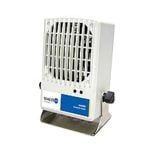
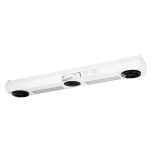
Three formats cover most applications: the bench-top ioniser (blower) for a single workstation, the air nozzle or gun for targeted cleaning and discharge, and the overhead ioniser bar for area coverage of whole lines. The choice depends on reach and process.
| Type | Coverage | Typical use |
|---|---|---|
| Bench-top ioniser (blower) | single workstation | hand soldering, rework, test bench |
| Air nozzle / gun | spot, directional | de-dusting and discharging housings, films |
| Overhead ioniser bar | line / conveyor | assembly, packaging, roll goods |
The bench-top blower is the most common solution in hand soldering and rework. The nozzle and gun also remove particles with compressed air and suit plastic housings and displays. The overhead bar covers moving goods where a fixed layout is not enough.
Frequently asked questions
Why can an insulator not simply be grounded?
An insulator is not dissipative. A ground connection cannot carry the charge away because the material blocks charge transport. Only air ions reach the surface and balance the charge.
How often should an ioniser be checked?
Offset voltage and decay time should be measured regularly, typically every 6 to 12 months under IEC 61340‑4‑7. Check more often for critical processes or abnormal readings. The emitter points must also be kept clean.
What does an offset voltage near 0 V mean?
It shows that positive and negative ions are emitted in balance. A high offset means the ioniser itself produces a residual charge and charges objects instead of neutralising them.
Find the right ioniser
From bench-top blower to overhead bar - we help with selection, offset measurement and integration into your EPA.
To IEC 61340-4-7
Offset and decay assessed against the recognised test standard.
Backed by measurement
Charged-plate-monitor values instead of vendor claims alone.
Regular control
Clear check intervals for balance and effectiveness.
Selection help
We help you choose the right products; technical details are clarified with the manufacturer.