
How do you test and adjust an air ionizer correctly?
An ionizer neutralizes charges on insulators, but only when it is balanced and fast enough. This guide shows how to test offset voltage and decay time per DIN EN 61340-4-7 with a charged-plate monitor, adjust the balance and set sensible maintenance intervals.
View ionizersContents
What do you measure on an ionizer?
An ionizer produces positive and negative ions to neutralize charges on non-conductive materials. Two quantities are tested: the offset voltage (balance) and the decay time. Both are measured with a charged-plate monitor as defined in DIN EN 61340‑4‑7.
The offset voltage shows whether the ionizer works in equilibrium. An imbalance means the unit itself deposits a residual charge on the part. The decay time states how quickly a defined test plate falls from 1000 V to 100 V - it describes effectiveness at the workstation.
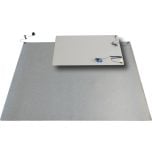
How do you measure offset voltage and decay time?
Testing takes place at the actual location and distance, because airflow and range strongly affect the readings. The CPM sits where the part would normally be, and the plate is charged to +1000 V and -1000 V.
- Place the CPM at the real working distance, not right in front of the nozzle.
- Charge the plate to +1000 V and time the fall to 100 V, then repeat with -1000 V.
- Read the offset once the plate is discharged and the ionizer keeps running.
- Record readings, distance, date and operator.
- Clearly different times for + and - point to a balance problem.
How do you adjust the balance?
If the offset voltage exceeds the limit, the balance must be corrected. Many stationary ionizers offer a potentiometer or an automatic loop that trims the ion ratio. On emitter-point units, contamination is usually the cause.
- Clean emitter points with the supplied cleaning tool or a swab and alcohol.
- Deposits raise the offset voltage and noticeably lengthen the decay time.
- After cleaning, measure again with the CPM and readjust the balance control if needed.
- Check air pressure and airflow on compressed-air ionizers, as they set the ion volume.
What maintenance intervals make sense?
Ionizers lose effectiveness over time as the emitters foul. Periodic CPM verification therefore belongs in the ESD control program per DIN EN 61340‑5‑1, which requires verification and maintenance.
Frequently asked questions
What offset voltage is acceptable?
A limit of ± 35 V is common in the EPA, and the exact value is set in the ESD control program based on process risk. Sensitive processes require values close to zero.
How fast must an ionizer discharge?
Decay time from 1000 to 100 V is often below 20 seconds, but it depends on distance and application. What matters is the sensitivity of the parts, not a blanket figure.
Why measure at the real working distance?
Decay time and balance change with distance and airflow. Only a measurement at the actual location with a documented distance shows the real effectiveness.
How often must an ionizer be tested?
A full CPM test every 6 to 12 months is common, while emitters are cleaned monthly to quarterly depending on fouling. The intervals belong in the control program.
Looking for an ionizer or charged-plate monitor?
We supply regulated ionizers and test equipment for measuring offset voltage and decay time per DIN EN 61340-4-7.
Standards-based
Test method per DIN EN 61340-4-7.
Measurable
Charged-plate monitor for reliable values.
Documented
Offset and decay time traceably recorded.
Selection help
We help you choose the right products; technical details are clarified with the manufacturer.