
ESD clothing: how do you use smocks and textiles correctly?
ESD smocks and textiles have a conductive grid woven into the fabric. They contain and shield the charge of the ordinary clothing worn underneath, but they do not replace a wrist strap. This guide explains how they work, the standards and the care that keeps the grid effective - to IEC 61340-5-1.
View ESD clothingHow does ESD clothing work?
An ESD smock has a conductive grid woven into the fabric. It surrounds the wearer and shields the charge of the ordinary clothing worn underneath, so that clothing emits no field onto sensitive devices. The smock thus protects the device from the person.
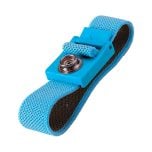
Important: the smock does not replace personnel grounding. The conductive grid contains the charge of the clothing, but it only grounds the wearer's body if a groundable variant is connected to the grounding point via a cuff or wrist. To drain the body charge, the wrist strap remains mandatory.
| Garment type | Use | Feature |
|---|---|---|
| ESD smock | standard protection in the EPA | grid fabric, snap fasteners |
| Groundable smock | higher requirement | grounding via cuff at the wrist |
| ESD shirt / base layer | worn under the smock | fully dissipative fabric |
| Gloves / finger cots | handling of devices | dissipative, complement the smock |
Which requirements and standards apply?
At system level IEC 61340‑5‑1 applies: clothing is part of the ESD control programme. The garments themselves are classified to IEC 61340‑13, and material resistances are measured to IEC 61340‑2‑3. This gives verifiable, documented proof of the shielding effect.
| Standard | Subject | Purpose |
|---|---|---|
| IEC 61340-5-1 | ESD control programme | clothing in the system, limit values |
| IEC 61340-13 | garments | classification and requirements |
| IEC 61340-2-3 | material | measuring the material resistance |
| Personnel grounding | wrist strap | stays mandatory, smock is no substitute |
How is the protective effect maintained?
The protective effect depends on an intact grid. Correct washing and care to the manufacturer's instructions keep the conductivity; the wrong detergent, fabric softener or too many cycles clog the grid and reduce dissipation. Check wear and resistance periodically.
- Wash only per the manufacturer's instructions, use no fabric softener.
- Check snaps and cuff contacts for a secure fit.
- Wear the smock closed so the ordinary clothing is fully shielded.
- Count wash cycles and measure the resistance periodically.
- Replace and document damaged or washed-out smocks.
Frequently asked questions
Does an ESD smock replace the wrist strap?
No. A standard smock only shields the charge of ordinary clothing. Draining the body charge still needs personnel grounding - a wrist strap or a groundable smock with a cuff connection.
To which standard is ESD clothing tested?
At system level IEC 61340‑5‑1 applies. The garments themselves are classified to IEC 61340‑13, and the material resistances are measured to IEC 61340‑2‑3.
Why does a smock lose its effect?
The conductive grid can clog through the wrong washing, fabric softener or many wash cycles. Correct care and a periodic resistance measurement keep the shielding effective.
ESD clothing for your EPA
Smocks, groundable variants and textiles with a conductive grid - compliant with IEC 61340-5-1, from a single source.
Standard-compliant
Clothing to IEC 61340-5-1 and IEC 61340-13.
Reviewed
Content reviewed by ESD specialists.
Full range
Smocks, textiles and grounding from one source.
Selection help
We help you choose the right products; technical details are clarified with the manufacturer.