
Common Ground Point at the ESD Bench - how to build it?
The common ground point (Earth Bonding Point, EBP) is the central node where the table mat, wrist strap and protective earth all meet. This guide explains how to build the bonding system to DIN EN 61340-5-1, connect every element correctly, and where the 1 MΩ resistors belong.
View grounding kitWhat is a common ground point?
The common ground point (Earth Bonding Point, EBP) is the central connection where every dissipative element of an ESD bench is bonded together and to earth. The aim is equipotential bonding: person, work surface and part sit at the same electrical potential, so no harmful discharge occurs.
An EBP is usually a small bonding box or bar with several 10 mm stud sockets and one cable to protective earth. Table mat, floor mat, wrist strap and tools all converge here. Under DIN EN 61340‑5‑1 the resistance from the EBP to protective earth should be below 1 Ω.
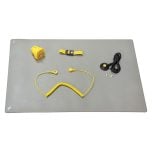
How do the mat, wrist strap and earth connect?
Each element gets its own lead to the EBP in a star topology, not daisy-chained. That keeps every link individually testable, and a fault at one point does not affect the others.
- Wrist strap: always with a 1 MΩ safety resistor in the coil cord, limiting touch current to safe values.
- Table mat: earth cable with an integrated 1 MΩ resistor at the stud.
- Protective earth: the fixed cable from the EBP to earth (PE) is low-ohm; no 1 MΩ resistor is allowed here.
- Star wiring: every branch runs separately to the EBP, never in a chain.
Why do the 1 MΩ resistors sit only near the person?
The 1 MΩ resistor limits current if a person accidentally touches a live part. That is why it sits in every line linking the human to earth - the wrist strap and the mat earth cable. The path from the EBP to protective earth, by contrast, stays low-ohm.
Static charge still drains fast enough through 1 MΩ (in fractions of a second) to protect sensitive parts. At the same time it avoids a sudden hard discharge pulse that could itself damage components.
- 1 MΩ typical per person-side line, sometimes up to 4 MΩ at higher mains voltages.
- EBP to PE: low-ohm, so the reference potential stays stable.
- Check resistors periodically with an ESD tester and record the values.
How is the EBP tested and maintained?
The whole earth path is measured regularly: from the wrist strap through the EBP to protective earth. An ESD resistance meter checks that values sit in the target range and that no lead is broken.
Frequently asked questions
Does every element need its own 1 MΩ resistor?
Only the person-side lines (wrist strap, mat earth) need the 1 MΩ safety resistor. The link from the EBP to protective earth must stay low-ohm and resistor-free.
Star or daisy-chain wiring?
Always star: each mat, wrist strap and tool runs separately to the common ground point. That keeps every branch individually testable and any fault stays local.
What does the EBP earth to?
To the protective earth (PE) of an earthed socket or a building earth bar below 1 Ω. Never to the neutral conductor or water, gas or heating pipes.
How often is the bonding checked?
The wrist strap daily before starting, the mat link monthly, and the EBP-to-PE path yearly or after any rebuild. Record values per DIN EN 61340‑5‑1.
Building a common ground point?
We supply EBP bonding boxes, 1 MΩ earth cables, wrist straps and testers - all verified to DIN EN 61340-5-1.
Standard-tested
All components meet DIN EN 61340-5-1.
Clean star point
EBP with a defined tie to protective earth.
Measurably safe
Resistances documented and testable.
Selection help
We help you choose the right products; technical details are clarified with the manufacturer.