
ESD Sensitivity Classes: Sorting HBM, CDM and MM
Not every component is equally sensitive to electrostatic discharge. This guide explains the three test models HBM, CDM and MM, their class limits in volts per ANSI/ESDA/JEDEC, and how to derive the right protection measures for your EPA.
View ESD protectionWhat sets HBM, CDM and MM apart?
Component sensitivity is described by three discharge models, because a discharge behaves differently in real conditions. HBM (Human Body Model) reproduces the discharge of a charged person, CDM (Charged Device Model) the discharge of a component charged by itself, and MM (Machine Model) the discharge through a metallic tool or machine.
HBM uses an equivalent circuit with a 100 pF capacitor and a 1.5 kΩ resistor, producing a relatively slow pulse in the microsecond range. CDM is far faster: the component is charged itself and discharges in under a nanosecond with high peak currents, which is especially critical for modern chips with fine structures.
Which sensitivity classes exist?
Components are graded by their breakdown voltage into classes. For HBM the scale runs from class 0 (below 250 V, extremely sensitive) to class 3B (above 8000 V). The lower the class, the stricter the protection measures must be.
CDM has its own classification with much lower voltage values, because a few hundred volts are already critical here. A component can be uncritical under HBM yet highly sensitive under CDM - so both figures from the datasheet must always be considered.
How do I derive protection measures?
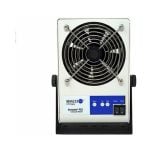
The class decides how strictly the EPA per DIN EN 61340‑5‑1 must be designed. For class 0 components a standard EPA is often not enough; here you need additional measures such as controlled ionisation and tighter limits.
- Class 2 and above: standard EPA with grounding, wrist strap and dissipative flooring.
- Class 1A/1B: add ESD packaging, documented resistance testing, trained staff.
- Class 0: also ionisation against insulators, reduced residual voltage, tighter test intervals.
- CDM-critical parts: slow handling, avoid rapid contact separation, conductive trays.
- Monitor residual voltages on insulators with a field meter.
Frequently asked questions
What does HBM class 0 mean?
Class 0 covers components with an HBM breakdown voltage below 250 V. They are considered extremely sensitive and require measures beyond a standard EPA, such as ionisation and tighter limits.
Why is CDM often more critical than HBM?
In CDM the component discharges itself in under a nanosecond with very high peak currents. Modern chips with fine structures are more vulnerable to this than to the slower HBM pulse.
Is the Machine Model still used?
MM is largely obsolete. The industry now relies on HBM and CDM because they reflect real behaviour better. MM is only rarely specified for new parts.
Where do I find a component's sensitivity class?
In the manufacturer datasheet under ESD ratings, usually split into HBM and CDM with a voltage value and class per ANSI/ESDA/JEDEC.
Need the right protection for your components?
From wrist straps to ionisers - we supply the right equipment to match the sensitivity class, tested to DIN EN 61340-5-1.
Standard-compliant
Equipment per DIN EN 61340-5-1 and ANSI/ESDA.
Class-matched
Measures matched to the HBM and CDM class.
Even class 0
Ionisation for extremely sensitive components.
Selection help
We help you choose the right products; technical details are clarified with the manufacturer.