
What is ESD and why is ESD protection necessary?
ESD (electrostatic discharge) is the sudden equalisation of different electrostatic charges. Usually harmless to people, it destroys sensitive electronic components - often unnoticed and permanently. Effective protection is only possible in a controlled, grounded environment (EPA).
View ESD protection rangeWhat does electrostatic discharge (ESD) mean?
ESD is the sudden equalisation of an electrostatic charge between two objects at different potentials. When a charged and a less charged body touch or come close enough, the charge flows away within fractions of a second - with currents that can destroy sensitive semiconductors.
The familiar "zap" when touching a door handle is such a discharge. What a person only feels above several thousand volts already damages modern components far below that.
How do electrostatic charges arise?
Charging occurs mainly through friction and separation of two materials (triboelectric effect). Electrons move from one material to the other - one body becomes positive, the other negative. Induction (charge shift in a field) charges objects too.
Why does ESD damage electronic components?
During discharge, the current flows through the component and overheats or punctures the finest semiconductor structures. The result is either a catastrophic failure (component defective at once) or latent damage: the component works at first but fails prematurely in the field. These hidden failures make ESD so treacherous.
To assess sensitivity, components are tested against three discharge models that reproduce real situations:
| Test model | Simulates the discharge | Standard / test voltage |
|---|---|---|
| HBM (Human Body Model) | of a charged person through a component | ANSI/ESDA/JEDEC JS-001 |
| MM (Machine Model) | of a charged machine part | approx. 100-200 V |
| CDM (Charged Device Model) | of a component charged in itself | ANSI/ESDA/JEDEC JS-002 |
Which components are particularly sensitive?
Most at risk are components with fine, insulated semiconductor structures. Electrostatic discharge sensitive (ESDS) devices include:
Thin gate oxides break down at low voltage.
Op-amps and A/D converters are sensitive to pre-damage.
High-frequency semiconductors have especially small structures.
Optoelectronics lose efficiency or fail through ESD.
Such parts carry the yellow ESDS warning triangle. They may only be handled inside an ESD protected area (EPA).
How do you protect components against ESD?
The basic principle is dissipate, do not insulate: all conductive and dissipative elements - people, work surfaces, floor - are connected to a common ground potential through defined resistances. This prevents damaging potential differences. That is the job of an EPA to DIN EN 61340‑5‑1.
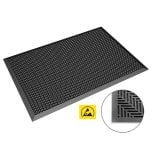

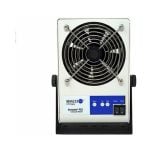
How to build such a protected area step by step is shown in the guide Setting up an EPA.
Frequently asked questions
Can you see ESD damage?
Usually not. Many failures are latent - the component works at first and only fails later. That is exactly why prevention matters more than troubleshooting.
At what voltage does ESD become critical?
Modern components can already be damaged from around 100 V (HBM), and even less in the CDM. A person, by contrast, only feels a discharge from about 2 to 3 kV.
Is an antistatic wrist strap enough?
No. The wrist strap only grounds the person at the bench. Effective ESD protection needs surface, floor, grounding and packaging working together - the complete EPA.
Set up your ESD protection to standard
Mats, wrist straps, floors, ionisers and packaging - compliant with DIN EN 61340-5-1, from a single source.
Standard-compliant
Products and advice to DIN EN 61340-5-1.
Reviewed
Content reviewed by ESD specialists.
Full range
Over 200 brands for the ESD workstation.
Selection help
We help you choose the right products; technical details are clarified with the manufacturer.