
Automotive ESD control: what AEC-Q100 adds to 61340-5-1
In automotive electronics the baseline protection of DIN EN 61340-5-1 is often not enough. This guide explains how the AEC-Q100 (ICs) and AEC-Q101 (discrete semiconductors) qualification standards define device sensitivity and what extra EPA requirements follow from them.
View ESD equipmentWhy is DIN EN 61340-5-1 not enough for automotive?
DIN EN 61340‑5‑1 describes how an ESD protected area (EPA) is built and operated - it is process oriented. AEC-Q100 and AEC-Q101 are device oriented qualification standards from the Automotive Electronics Council: they define which discharge an IC or semiconductor must survive in test.
The key point: automotive parts are getting so sensitive that their CDM withstand voltage drops below the classic EPA target values. 61340‑5‑1 requires baseline protection for parts from 100 V HBM. If your ICs are more sensitive, the EPA must be tightened.
Which HBM and CDM classes does AEC-Q define?
AEC-Q100 ranks parts by their withstand voltage. HBM simulates the discharge of a charged person through a finger, CDM the self discharge of a charged device on contact with a surface. In modern automated production CDM is often the more critical failure mechanism.
- A CDM class C0 IC (< 125 V) demands the strictest handling and ionized workstations.
- HBM class 1A (< 500 V) means even a poorly grounded person can destroy the part.
- The lower the number or class, the more sensitive the part and the stricter the EPA.
Which extra measures does practice require?
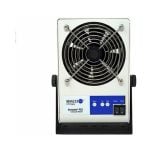
Once CDM withstand drops below about 200 V, grounding alone is not enough. Residual charges on insulating packaging, workpieces and process aids must be actively neutralized. The annex to DIN EN 61340‑5‑1 then recommends tighter limits and gap free ionization.
- Ionizers with offset balance within plus/minus 35 V at every CDM critical point.
- Continuous wrist strap monitoring instead of a once a day test.
- Process specific evidence (PCB, EPS) and regular verification with a field meter.
- Full traceability of ESD tests as part of the IATF 16949 documentation.
Frequently asked questions
Does AEC-Q100 replace DIN EN 61340-5-1?
No. AEC-Q100 qualifies the device and states its sensitivity, while 61340‑5‑1 governs the protected area. They complement each other: the device class decides how tight the EPA must be designed.
What is the difference between HBM and CDM?
HBM simulates the discharge of a charged person through a finger, CDM the self discharge of a charged device on contact. In automated processes CDM is usually the more common damage mechanism.
From what sensitivity is ionization mandatory?
As soon as insulating materials are unavoidable in the process or CDM withstand falls below about 200 V, area wide ionization with an offset within plus/minus 35 V is practically mandatory.
Why is the automotive target stricter than 100 V?
Because modern automotive ICs reach CDM classes below 125 V. The EPA residual voltage must stay well below that so even the most sensitive part is handled safely - typically under 35 V.
Upgrading an EPA for automotive production?
We supply ionizers, continuous monitoring systems and conductive packaging for CDM critical parts to AEC-Q100 and AEC-Q101.
Automotive proven
Equipment for CDM critical processes to AEC-Q.
Balanced ionization
Ionizers with offset within plus/minus 35 V.
Documented
Readings captured for IATF 16949 evidence.
Selection help
We help you choose the right products; technical details are clarified with the manufacturer.