
ESD Test Intervals: How Often Must You Verify?
Without regular verification, an ESD protected area silently loses its effect. This guide shows the typical test intervals for wrist straps, mats, floors and ionizers per IEC 61340-5-1 and how to build a compliant maintenance plan with proper documentation.
View ESD test equipmentWhy are fixed test intervals mandatory?
Resistance to ground drifts through wear, contamination and ageing. A wrist strap with a broken cord or a soiled mat looks intact but no longer dissipates safely. That is why IEC 61340‑5‑1 requires a compliance verification plan that defines intervals, test methods and limits.
The standard does not fix a single number for every case; it demands a risk-based decision. In practice, daily personnel tests and semi-annual to annual facility checks have proven reliable. Safety-critical or heavily used items are checked more often.
- Wear: broken ground cords, abraded mat surfaces.
- Contamination: flux, hand cream and dust insulate the surface.
- Ageing: ionizer emitters foul, floors lose dissipation.
- Evidence: auditors require unbroken test records.
Which interval applies to each item?
Personnel-worn equipment is tested daily, fixed equipment on longer cycles. The overview below sums up the common practical values that have proven reliable within the standard.
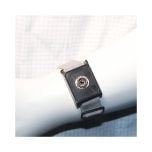 Use a wrist strap correctly
Fit, skin contact and the 1 MΩ resistor explained in detail.
View products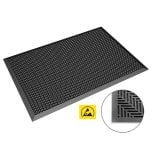
Which limits must be met?
Every test needs a defined limit to measure against. Only then can a pass or fail be documented. Here are the key reference values of IEC 61340‑5‑1 at a glance.
- Before measuring, record the test environment: temperature and relative humidity.
- For ionizers, capture offset voltage and discharge time from +1000 V and -1000 V.
- Log every measurement with date, value, tester and result.
What does a compliant maintenance plan look like?
A maintenance plan links each item to its interval, method, limit and responsible person. It is the documented implementation of the compliance verification plan and must be available for audits.
- Inventory of every ESD item per workstation with a unique identifier.
- Assigned interval (daily, semi-annual, annual) for each item.
- Defined test method and limit per IEC 61340‑5‑1.
- Responsible person and deputy for every check.
- Record template with date, reading, result and signature.
- Escalation on failure: block, replace, re-measure, release.
Frequently asked questions
How often must a wrist strap be tested?
Before every shift, so daily, with a wrist strap tester. Alternatively a constant monitor provides continuous supervision during work.
How often are mats and floors tested?
Typical intervals are 6 to 12 months with a resistance meter to the grounding point. The value must stay below 1 x 10⁹ Ω.
How is an ionizer verified?
A charged plate monitor measures offset voltage and discharge time. The offset should typically be ±35 V or lower, checked every 6 to 12 months.
Do I have to document the tests?
Yes. IEC 61340‑5‑1 requires a compliance verification plan with logged readings, date, tester and result as evidence for audits.
Looking for a plan and test equipment?
We supply wrist strap testers, resistance meters and charged plate monitors - suited to a maintenance plan per IEC 61340-5-1.
Standard-compliant
Test methods per IEC 61340-5-1.
Documented
Record templates for unbroken evidence.
Calibrated
Instruments with annual calibration record.
Selection help
We help you choose the right products; technical details are clarified with the manufacturer.