
SMD Rework and Repair - how to desolder parts safely?
SMD rework means removing and replacing surface-mount parts on populated boards in a controlled way - without damaging the board, neighbouring parts or pads. This guide covers hot-air work, BGA repair basics, the key tools and the mistakes to avoid.
View rework toolsWhat does hot-air SMD rework involve?
SMD rework is the targeted removal and re-fitting of surface-mount components. Instead of a soldering tip, a hot-air gun heats every joint evenly and without contact until the solder melts, so even multi-pin parts release in one go.
Airflow and temperature at the right nozzle are decisive. Lead-free solder (SAC305) melts at around 217 °C, classic Sn63Pb37 already at 183 °C. The hot-air station is set to suit the alloy and thermal mass, not simply run at maximum.
- Shield neighbouring parts from the heat with Kapton tape or shielding plates.
- Large parts need bottom preheating so the board does not warp.
- Always use the smallest nozzle that fully covers the component.
What does a safe temperature profile look like?
A rework profile follows the same phases as a reflow oven: preheat, thermal soak, reflow and cooling. Driving the board straight to reflow temperature risks delamination, the popcorn effect and cold joints.
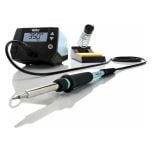 Choose a station
Iron, hot air or combi unit - find the right soldering station for the job.
View productsWhat matters most in BGA repair?
On a BGA (Ball Grid Array) the solder balls sit hidden under the package. Removal, pad cleaning, reballing and precise placement only succeed with even heat input and a rework station that offers bottom heating.
- Lift the old part at full reflow temperature without scratching the pads with the tip.
- Wick residual solder flat with braid and flux, then clean with IPA.
- Reball the new BGA with a stencil or use a pre-balled part.
- Align to the package edge - many BGAs self-centre during reflow through surface tension.
- After soldering, inspect for bridges and voids by X-ray or endoscope where possible.
Which tools and mistakes decide the outcome?
Good rework depends on the accessories. Flux, desoldering braid, vacuum tweezers and a dissipative work area shape the result as much as the station itself.
- No-clean or water-soluble flux for clean, well-wetted joints.
- Desoldering braid and a solder pump to remove excess solder.
- Vacuum tweezers to lift and place parts without vibration.
- An ESD workstation with mat and wrist strap protects sensitive ICs.
- A loupe or digital microscope for visual inspection of the joints.
Frequently asked questions
What hot-air temperature do I need to desolder SMDs?
As a guide, 30 to 40 °C above the solder melting point at the joint: for lead-free (SAC305, melting point 217 °C) roughly 250 to 290 °C nozzle temperature, lower for leaded solder. Component mass and board size shift the value.
Can I repair BGA parts reliably without X-ray?
The soldering itself works with a good rework station and bottom heating. Without X-ray, however, checking for hidden bridges and voids stays guesswork. For production or safety-relevant assemblies, X-ray inspection is advisable.
Why do some packages crack open during rework?
That is the popcorn effect: trapped moisture flashes to vapour and bursts the plastic package. Drying (baking) moisture-sensitive parts before soldering prevents it.
Do I really need an ESD workstation for SMD rework?
Yes. Many ICs are electrostatically sensitive and can be damaged unnoticed by discharges. A dissipative mat, wrist strap and grounded station are part of the basic setup.
Looking for SMD rework equipment?
From the hot-air station to flux, braid and a full ESD workstation - we supply the right rework gear for repair and modification work.
Precise control
Hot-air stations with stable temperature and airflow control.
ESD-safe
Dissipative workstations protect sensitive components.
Complete accessories
Flux, braid, nozzles and vacuum tweezers from one source.
Selection help
We help you choose the right products; technical details are clarified with the manufacturer.