
Hot air rework: how do I replace SMD components without touching them?
In hot air rework a hot air stream heats the solder joints without touching the component. This lets you cleanly remove and replace SMD parts such as QFP, chips and connectors. Large boards need preheating against thermal shock, plus the right nozzle, temperature profile and flux.
View hot air stationsHow does hot air rework work?
A hot air station blows a controlled hot air stream onto the solder joints and melts the solder without mechanically touching the component. This heats all pins of a multi-lead SMD part - QFP, chips, connectors - evenly and at the same time, so it can be removed and replaced. A soldering iron cannot do this.
How do I replace an SMD component step by step?
The rework workflow follows a fixed pattern: preheat, apply flux, remove the part, clean the pads, place the new part with solder paste and reflow it in the hot air stream. Large boards must be preheated to avoid thermal shock.
| Step | Action | Note |
|---|---|---|
| 1 Preheat | bring the board to 120-150 °C | protects against thermal shock and delamination |
| 2 Flux | apply flux to the solder joints | improves heat transfer and wetting |
| 3 Remove | heat the part with hot air and nozzle | lift only when the solder is fully liquid |
| 4 Clean pads | remove residual solder with braid | flat, clean pads for the new part |
| 5 Place | apply solder paste, align the part | check position and polarity before reflow |
| 6 Reflow | heat in the air stream until it melts | even profile, let it cool slowly |
Choosing nozzle, temperature and airflow
Match the nozzle to the component: the right nozzle concentrates the heat on the part and protects its neighbours. Lead-free solders need about 300 to 350 °C nozzle temperature; set the airflow so it melts the solder but does not blow small parts away.
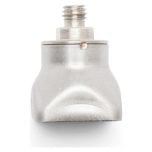
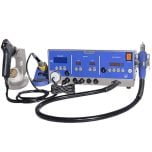
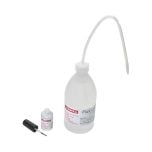
- Small chip: narrow nozzle, moderate airflow so the part does not shift.
- QFP and fine pitch: area nozzle for even heat across all leads.
- Connectors with much mass: higher temperature or longer preheating.
For how solder paste and temperature control interact see Reflow soldering. To pick the base station see Choosing a soldering station.
| Criterion | Soldering iron | Hot air |
|---|---|---|
| Contact | touches the joint | no contact |
| Suited to | through-hole (THT), single points | SMD: QFP, chips, connectors |
| Leads | one after another | all at once |
Frequently asked questions
When do I need hot air instead of a soldering iron?
A soldering iron suits through-hole parts and single joints. For SMD components with many leads - QFP, chips, connectors - hot air is better because it heats all leads at once and without contact.
Why must large boards be preheated?
Large boards sink a lot of heat and react badly to sudden heating. Preheating to about 120‑150 °C reduces thermal shock, prevents delamination and gives even melting.
Do I need flux for hot air rework?
Yes. Flux improves heat transfer and wetting so the solder flows cleanly. For placing new parts you additionally use solder paste, which already contains solder and flux.
Hot air stations for clean SMD rework
Stations, nozzles, flux and solder paste - ESD-safe and from a single source.
ESD-safe
Stations for the ESD workstation.
Reviewed
Content reviewed by soldering specialists.
Accessories
Nozzles, flux and solder paste in stock.
Selection help
We help you choose the right products; technical details are clarified with the manufacturer.