
THT vs SMD soldering: what is the difference?
THT and SMD are two ways to mount parts on a circuit board. With THT (through-hole) the leads go through drilled holes and are soldered on the other side - robust, ideal for connectors and power. SMD parts sit on surface pads, are smaller and allow higher density.
View soldering toolsWhat separates THT and SMD?
The difference is how parts are mounted. With THT (through-hole technology) the component leads pass through drilled holes and are soldered on the opposite side. With SMD (surface-mount device) the part sits flat on solder pads on the same surface - no hole.
- THT: mechanically robust, good for connectors, relays and power parts
- SMD: small and light, high packing density, both-side placement possible
- Many assemblies combine both techniques on one board
THT vs SMD - the direct comparison
THT wins on mechanical load and hand soldering, SMD on miniaturisation and automation. The table sums up size, technique and use:
| Feature | THT | SMD |
|---|---|---|
| Size | larger, with leads | smaller, no long leads |
| Mounting | leads through the hole | part on surface pad |
| Soldering | other side, iron or wave | reflow, hot air or fine tip |
| Hold | very robust, pull-resistant | flat, less mechanical load |
| Use | connectors, power, relays | high density, ICs, passives |
Which tools and technique do I need?
THT is soldered by hand with an iron and solder wire on the solder side. SMD is soldered in volume in a reflow oven, but can also be done by hand with a fine tip, flux and tweezers, or with hot air.
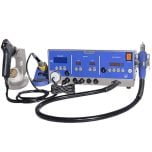 THT by hand
Iron, medium tip, solder wire - insert the leads and solder on the opposite side.
View products
Frequently asked questions
What is the difference between THT and SMD?
With THT the component leads pass through drilled holes and are soldered on the other side. SMD parts sit flat on solder pads on the surface, with no hole. THT is more robust, SMD smaller and denser.
Can SMD be soldered by hand?
Yes. In volume SMD is soldered in a reflow oven, but by hand it works with a fine tip and flux or with a hot-air station. Very small packages are demanding but feasible.
When do you use THT instead of SMD?
THT is used for mechanically loaded parts: connectors, relays, large capacitors and power components. SMD dominates where high packing density and automation matter.
The right technique for THT and SMD
Soldering stations, fine tips and hot air for through-hole and surface-mount work - from a single source.
Reviewed
Content reviewed by soldering specialists.
ESD-safe
Tools for the ESD workstation.
Wide range
For THT and SMD alike.
Selection help
We help you choose the right products; technical details are clarified with the manufacturer.