
How to choose a hot air rework station for SMD
A hot air rework station reflows and removes SMD components without touching the pads. This guide explains what matters in temperature control, airflow and nozzle selection, and how to match the tool to your boards.
View rework stationsHow does a hot air rework station work?
A hot air rework station heats a directed stream of air that melts the solder under an SMD component without mechanical contact with the pads. A heating element warms the air, a fan or diaphragm pump moves it through a nozzle, and a sensor keeps the temperature on target.
There are two designs: on a turbine station the fan sits in the handpiece, while on a compressor or diaphragm-pump station it sits in the base. Turbine units are quieter and lighter, pump units give steadier pressure for fine nozzles.
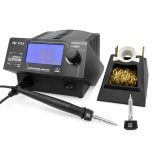 Choosing a soldering station
For through-hole parts and touch-up, the iron pairs with hot air.
View productsWhy is temperature control decisive?
Lead-free solder (SAC305) melts at about 217‑220 °C, leaded solder (Sn63Pb37) at 183 °C. At the joint you need 30‑40 °C more so the solder flows reliably. A good station holds the set point to about ±5 °C and compensates for heat loss as airflow rises.
- Digital readout of the actual temperature, not just the set point.
- Automatic cool-down protects the heating element and handpiece.
- Stand-by or auto-off lowers the temperature when idle.
How do I choose airflow and nozzle set?
Airflow and nozzle decide how focused the heat arrives. A large IC needs high volume and a wide nozzle, a single 0402 resistor only a little air and a narrow nozzle. Too much airflow blows small parts away or shifts neighbouring components.
- Round nozzles for single small parts and pinpoint heating.
- Slot and square nozzles for QFP, SOIC and BGA so all pins heat at once.
- Choose a nozzle close to the package outline to concentrate the heat.
- Preheating the board from below reduces warping and delamination.
- The nozzle set should match the package sizes you use most.
Frequently asked questions
What temperature for lead-free SMD soldering?
Set 340‑380 °C. SAC305 melts at about 217 °C, and a clear margin at the nozzle is needed to offset heat loss to the board and part.
How do I stop small parts from flying off?
Reduce the airflow and use a narrow nozzle. If needed, fix neighbouring parts with heat-resistant Kapton tape.
Do I need preheating?
For BGA and large multilayer boards, yes. Bottom preheat to 100‑150 °C reduces thermal shock, warping and the risk of cold joints.
Turbine or pump station?
Turbine units are lighter and quieter, pump or compressor units give steadier pressure for fine nozzles and longer work without heating up the handpiece.
Looking for the right SMD rework station?
We supply hot air rework stations with precise temperature control, adjustable airflow and matching nozzle sets for every package size.
Precisely controlled
Stable actual temperature within about ±5 °C.
Fine airflow
Finely dosable from 0402 to BGA.
Matching nozzles
Standard nozzle sets and spares available.
Selection help
We help you choose the right products; technical details are clarified with the manufacturer.