
How to choose and store solder paste correctly?
Solder paste is a mix of solder alloy powder and flux, applied by stencil printing onto the pads and reflow soldered. The choice depends on alloy, powder class and pitch. Cold storage and correct warm-up decide the print quality and shelf life.
View solderingWhat is solder paste and which alloy fits?
Solder paste is a mix of fine solder powder and flux. The flux makes the paste printable, keeps it tacky (tack) and cleans the surfaces during heating. In stencil printing the paste is deposited on the SMD pads, then the parts are placed and reflow soldered in the oven.
The standard today is the lead-free alloy SAC305 (Sn96.5/Ag3.0/Cu0.5), widely used in RoHS-compliant electronics manufacturing. Leaded pastes (SnPb) melt lower and are only allowed where exemptions apply (such as certain aerospace, medical and military applications). The alloy sets the reflow profile.
Which powder class (Type) do I need?
The powder class (Type) describes the particle size of the solder powder per J-STD-005. The finer the pitch and the smaller the apertures, the finer the powder must be so the paste releases cleanly from the openings. Powder that is too coarse clogs fine apertures, powder that is too fine oxidises faster.
| Type | Particle size | Use |
|---|---|---|
| Type 3 | 25-45 µm | Standard SMD, common pitch from 0402 |
| Type 4 | 20-38 µm | Fine pitch, small chips, fine QFP |
| Type 5 | 15-25 µm | Ultra-fine pitch, 0201, micro-BGA |

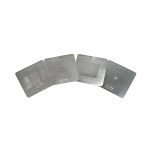
The powder class is closely tied to the stencil: see foil thickness and apertures in the article Using a solder stencil.
How do I store and process solder paste correctly?
Solder paste is stored cold, typically at 2‑10 °C in a refrigerator, and has a limited shelf life. Before opening, let the sealed jar warm up to room temperature so no condensation forms. Do not refreeze and respect the manufacturer's expiry date.
| Point | Recommendation | Why |
|---|---|---|
| Storage temperature | 2-10 °C refrigerated | Slows the reaction of powder and flux |
| Before use | Warm up while sealed | Prevents condensation in the paste |
| Do not freeze | No refreezing | Avoids separation and demixing |
| Shelf life | Respect expiry date | Tack and print quality fade over time |
- Store the paste sealed in the fridge at 2‑10 °C.
- Before opening, let it warm to room temperature for several hours.
- Stir briefly and evenly before printing if the maker recommends it.
- Take out only as much as you will process shortly.
- Do not refreeze opened paste, and note the date.
- On the stencil, keep within the maker's maximum open time.
- Do not return residue to the original jar, to avoid ageing.
After paste printing comes the oven process: more in the article Reflow soldering.
Frequently asked questions
At what temperature is solder paste stored?
Typically refrigerated at 2‑10 °C, per the manufacturer's data. Before opening, bring the sealed jar to room temperature so no condensation forms. Do not refreeze.
What does Type 3, 4 or 5 mean?
The powder class describes the particle size of the solder powder per J-STD-005. Type 3 (25‑45 µm) is standard, Type 4 (20‑38 µm) for fine pitch, Type 5 (15‑25 µm) for ultra-fine pitch. Finer pitch needs finer powder.
Lead-free or leaded?
SAC305 is the lead-free standard under RoHS and right for most applications. Leaded SnPb pastes melt lower and are only allowed where exemptions apply, such as certain aerospace, medical and military areas.
Solder paste and accessories from one source
Matching alloy, powder class and consumables for a clean paste print.
Reviewed
Content reviewed by soldering specialists.
Matching range
Solder paste, stencils and accessories in stock.
Practical
Neutral, actionable recommendations.
Selection help
We help you choose the right products; technical details are clarified with the manufacturer.