
Soldering Accessories - what belongs on every bench?
Beyond the station itself, the right accessories decide clean joints and long tip life. This guide covers the basics: iron holder, dry and tip cleaners, flux pen and soldering mat - with a checklist for a complete bench.
View soldering accessoriesWhy are the iron holder and cleaner the foundation?
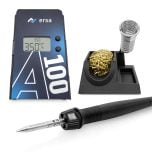
The iron holder keeps the hot soldering iron safe and prevents burns and cable damage. Together with a tip cleaner it forms the base of every bench, because a clean, well-tinned tip is the precondition for shiny, reliable joints.
Two cleaning principles are common. The dry cleaner with brass wool strips off oxides and residue without cooling the tip - ideal during ongoing work. The classic wet sponge cleans with distilled water but briefly lowers the tip temperature.
- Iron holder with a stable base and a coil spring matched to the iron.
- Dry cleaner with brass wool for cleaning between joints.
- Wet sponge from cellulose-free material, dampened with distilled water.
- Tip activator to regenerate heavily oxidised tips.
How do tip activator and flux keep the tip fit?
Even with good care a tip loses its wetting over time: solder beads up instead of adhering. A tip activator made of fine abrasive powder and flux restores the tinnable surface without damaging the plated iron layer.
The flux pen delivers extra flux exactly where it is missing - when reworking old joints or desoldering. It dissolves oxides and improves heat transfer so the joint flows reliably.
What does a soldering mat do and what else is missing?
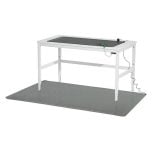
The soldering mat made of heat-resistant silicone protects the desk from solder splashes and hot tools. Many models are dissipative (ESD) and offer magnetic trays for screws and small parts - ideal for sensitive electronics.
A complete bench also needs desoldering braid, tweezers, side cutters and a fume extractor or solder smoke filter. For ESD assemblies, a wrist strap and dissipative surface round out the setup.
- Silicone soldering mat, heat resistant to around 500 °C, dissipative for ESD.
- Desoldering braid and pump for corrections.
- Precision tweezers and side cutters in hardened steel.
- Solder fume extractor with activated carbon filter for clean air.
Frequently asked questions
Dry cleaner or wet sponge - which is better?
The dry cleaner with brass wool does not cool the tip and preserves the tinning, ideal for ongoing work. The wet sponge cleans thoroughly but briefly lowers the temperature. Many professionals use both in parallel.
Why do I need a flux pen?
It applies flux precisely to oxidised or hard-to-wet spots, for example when reworking or desoldering. The flux dissolves oxides and improves heat transfer so the solder flows cleanly.
How often should I regenerate the tip?
As soon as the tip goes dull and solder beads up. A tip activator restores wetting in seconds. With regular care a tip lasts many times longer.
Does the soldering mat have to be dissipative?
For general soldering a heat-resistant silicone mat is enough. For sensitive electronics the mat should be ESD-dissipative and grounded to protect components from static discharge.
Looking for a complete accessory set?
From iron holder and dry or tip cleaner to flux pen and ESD soldering mat - we supply the full essentials.
Perfectly matched
Accessories fit common soldering stations and tips.
Heat resistant
Mats and holders built for continuous use.
ESD-ready
Dissipative mats for sensitive electronics.
Selection help
We help you choose the right products; technical details are clarified with the manufacturer.