
How to choose a heat-resistant soldering mat
A soldering mat protects your bench from heat, solder splashes and aggressive flux, and keeps small parts in place at an ESD workstation. This guide explains how to choose the temperature rating, the ESD properties to DIN EN 61340-5-1, the silicone material and the right size for your bench.
To the guidesHow heat-resistant does a soldering mat need to be?
The single most important property is the temperature rating. A good silicone soldering mat withstands a continuous temperature of around 250 °C and survives short peaks up to roughly 500 °C, as caused by a hot iron or a parked desoldering tool.
Silicone conducts heat slowly and does not melt; it only chars at very high temperatures. That protects the tabletop underneath and stops the mat deforming every time the tip touches it by accident.
- Continuous temperature: the value the mat tolerates permanently in use (silicone approx. 250 °C).
- Short peak: momentary contact with tip or hot-air nozzle (up to approx. 500 °C).
- Non-slip underside so the mat does not shift when the cable is pulled.
- Resistance to flux, isopropanol and stray solder.
What ESD properties does the mat need?
At an ESD-protected workstation a heat-resistant mat alone is not enough. It must be dissipative and connected to the common ground point in a controlled way, through a stud and a grounding cable with a 1 MΩ resistor.
To DIN EN 61340‑5‑1 the resistance to ground should sit in the range of about 10⁶ to 10⁹ Ω. That lets static charge drain quickly enough without exposing sensitive semiconductors to a sudden discharge current.
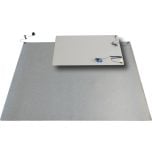
Which size and features suit your bench?
Size follows the working area in front of the operator. For repairs and small batches around 300 x 200 mm is enough, while larger assemblies or hot-air rework call for 450 x 300 mm or more.
Many soldering mats come with structured zones: magnetic areas and wells for screws, compartments for components and labelling fields. That stops small SMD parts rolling away and records the order in which you disassemble a device.
- 300 x 200 mm: compact for repair and a single position.
- 450 x 300 mm and larger: rework, hot air and bigger assemblies.
- Wells and magnetic zones for screws and SMD parts.
- Soft surface protects displays and housings from scratches.
Frequently asked questions
What temperature can a silicone soldering mat handle?
Typical silicone mats tolerate around 250 °C continuously and short peaks up to roughly 500 °C. That covers momentary contact with the tip, hot components and a hot-air nozzle.
Is every heat-resistant mat also ESD-safe?
No. Many silicone mats are insulating. For an ESD bench the mat needs a stated dissipative resistance of 10⁶ to 10⁹ Ω and grounding through a 1 MΩ cable to DIN EN 61340‑5‑1.
Which size makes sense?
About 300 x 200 mm is enough for repairs. For hot-air rework or larger assemblies 450 x 300 mm or more is more comfortable, ideally with wells and magnetic zones for small parts.
How do I clean the soldering mat?
Use a dissipative ESD cleaner or isopropanol and a soft cloth. Avoid silicone-based or greasy care products, as they leave an insulating film.
Looking for the right soldering mat?
Heat-resistant silicone soldering mats in dissipative ESD form are tested to DIN EN 61340-5-1 - more in our guides.
Heat-resistant
Silicone to around 250 °C continuous, peaks to 500 °C.
Standard-tested
ESD version to DIN EN 61340-5-1.
Cleanly grounded
Stud and 1 MΩ grounding cable in the set.
Selection help
We help you choose the right products; technical details are clarified with the manufacturer.