
Soldering iron or soldering station - which is better?
A plain soldering iron heats at a fixed power with no regulation, while a soldering station holds the tip temperature with closed-loop control and adds a tip family, a safe stand and usually ESD protection. Occasional jobs are fine with an iron; frequent work, sensitive components and lead-free solder favour a station.
Browse solderingWhat is the difference between an iron and a station?
The core difference is temperature regulation: a plain soldering iron is tied to the mains and delivers a fixed heating power with no feedback, so the tip temperature drifts under load. A soldering station measures the tip temperature continuously and corrects it in a closed loop, adding interchangeable tips, a safe stand and, in ESD versions, dissipative materials.
When is a soldering station worth it?
A soldering station is worth it once you solder regularly, handle temperature-sensitive or SMD components, or work with lead-free solder. The constant tip temperature protects parts and traces, the interchangeable tips cover fine and coarse joints alike, and the ESD version prevents damage to electrostatically sensitive components.
- Frequent or daily soldering in repair, production or the lab
- Sensitive semiconductors, SMD parts and modern circuit boards
- Lead-free solder with higher temperature demands
- Workbenches with ESD protection requirements
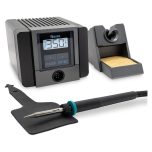
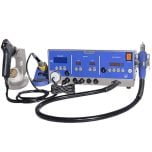
When does a plain soldering iron suffice?
A plain soldering iron is enough for occasional, non-critical work: joining cables, sturdy terminals, coarse joints or rare household repairs. As long as the parts are thermally robust, no ESD protection is required and use stays infrequent, the added value of a station rarely justifies the purchase.
- Occasional repairs without sensitive electronics
- Coarse joints on cables and terminals
- No need for adjustable temperature
- No ESD protection required
Frequently asked questions
Is a soldering station useful for beginners?
Yes. The constant temperature makes results more repeatable and reduces the risk of cold joints or overheated parts, which helps beginners more than a fixed-power iron.
Can a plain soldering iron handle lead-free solder?
It can for small, robust joints, but without regulation the tip temperature drops on larger joints. A regulated station keeps the temperature stable and is the safer choice for regular lead-free work.
Do I really need ESD protection?
For sensitive semiconductors and modern boards, yes. Electrostatic discharge can cause hidden damage, so an ESD-safe station and workplace are recommended whenever such components are involved.
Find the right soldering equipment
From plain soldering irons to regulated ESD stations - we help you choose for your application.
Selection help
We help you choose the right products; technical details are clarified with the manufacturer.
Selection help
We help you choose the right products; technical details are clarified with the manufacturer.
Hands-on knowledge
Recommendations based on real soldering work.
Selection help
We help you choose the right products; technical details are clarified with the manufacturer.