
How to choose an anti-static anti-fatigue mat?
An anti-static floor mat does two jobs at a soldering station: it drains charge safely to ground and cushions the operator during long standing hours. This guide shows how to match resistance to ground per IEC 61340-5-1, ergonomics, material and grounding.
View floor matsContents
Why use a conductive floor mat at the bench?
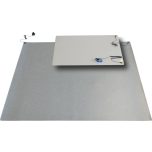
An anti-static floor mat serves two purposes at once at the soldering station: it drains electrostatic charge from the operator and chair safely to ground, and as an anti-fatigue mat it cushions hours of standing. Together with ESD footwear or heel grounders it forms the dissipative floor of the EPA (ESD Protected Area).
A dissipative floor discharges staff as they walk, so they carry no charge to sensitive assemblies. Under IEC 61340‑5‑1 a system is considered safe when body voltage stays below 100 V and the resistance to ground meets the limits.
What resistance to ground is required?
The decisive value is resistance to ground (Rg). For dissipative floors IEC 61340‑5‑1 names a range of roughly 10⁶ to below 10⁹ Ω. Too low discharges too fast and offers weaker mains-contact protection, too high no longer drains charge reliably.
- Always measure the system with the footwear actually worn, not the mat alone.
- At least one ground cord per mat to the common ground point.
- Grounding through a 1 MΩ safety resistor limits current on mains contact.
- Verify resistances periodically and record them in the test log.
What matters for ergonomics and material?
At a standing bench, cushioning matters as much as resistance. Anti-fatigue mats 12 to 18 mm thick, in dissipative PUR foam or studded NBR rubber, prompt small calf-muscle movements and noticeably reduce load on the back and joints.
- Bevelled edges prevent trip hazards and let carts roll over easily.
- Choose a heat-resistant surface so solder splashes cannot burn holes.
- A slip-resistant closed surface makes ESD cleaning easier.
- Match mat size to the standing zone, typically 60 x 90 cm to 90 x 150 cm.
How are the mats grounded and maintained?
The mat connects via a snap and a ground cord with a 1 MΩ resistor to the common ground point (EBP). Clean it with a dissipative ESD cleaner and a soft cloth.
- Mark the ground point visibly and route the cord with strain relief.
- Spot-check resistance to ground after cleaning.
- Replace the mat at visible wear or cracks, as aged surfaces lose conductivity.
Frequently asked questions
Should the floor mat be conductive or dissipative?
Dissipative at 10⁶ to below 10⁹ Ω per IEC 61340‑5‑1 is enough for the EPA. Fully conductive floors below 10⁶ Ω only make sense for very high demands and raise the shock risk.
Does the mat replace a wrist strap?
No. At a seated bench the wrist strap remains the primary ground. The floor mat works with dissipative shoes, mainly while standing and walking.
How thick should an anti-fatigue mat be?
For standing work 12 to 18 mm works well. That thickness cushions noticeably yet stays stable enough that footing is not compromised.
How often must resistance be checked?
Regularly per your test plan, at least yearly and after every deep clean. The readings belong in the ESD test log.
Looking for the right anti-static floor mat?
We supply dissipative floor and anti-fatigue mats with a grounding kit - tested to IEC 61340-5-1.
Standard tested
Floors meet IEC 61340-5-1.
Ergonomic
Anti-fatigue cushioning for long standing.
Fully grounded
Grounding kit with 1 MΩ cord included.
Selection help
We help you choose the right products; technical details are clarified with the manufacturer.