
Choosing a tool trolley: what matters?
A tool trolley brings tools mobile to the workplace. What matters is the number and height of drawers, their load rating, ball-bearing full-extension slides, a central lock and lockable castors. For electronics benches the trolley is also available in a dissipative ESD version.
View tool trolleysHow many drawers and which slides does the trolley need?
The number and height of drawers follow the tools: shallow compartments for bits and wrenches, tall ones for power tools and cases. What matters is the load rating per drawer and that the slides are ball-bearing and full-extension, so the content at the back stays within reach.
Which features are decisive on a tool trolley?
Besides the drawers, the lock, castors, worktop and total load rating decide the everyday value. The overview below shows what to look for in each feature:
| Feature | What to look for | Benefit |
|---|---|---|
| Drawers | number and height matched to tools, defined load | order and access |
| Slides | ball-bearing, full extension | full access, heavy load |
| Central lock | locks all drawers at once | security and transport |
| Castors | at least two with a brake | mobile and firmly fixed |
| Worktop | robust material, raised edge | work and set-down surface |
| Total load | sum matched to tool weight | stability |
When is an ESD version worthwhile?
At electronics workplaces an ordinary trolley can damage components through static charge. The ESD version uses dissipative surfaces, drawer liners and castors and drains charge in a controlled way - so the trolley fits into the EPA.
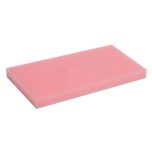 Dissipative liners
Drawer and top liners in dissipative material protect sensitive components.
View products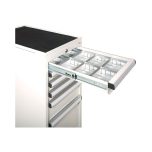
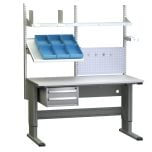
The trolley complements the fixed workplace - see the choice of a suitable workbench.
Frequently asked questions
How many drawers should a tool trolley have?
As many as usefully divide the tools you have - usually five to eight. More important than the sheer number is the mix of shallow and tall drawers and an adequate load rating per compartment.
Why are ball-bearing full-extension slides important?
A ball-bearing full-extension slide pulls the drawer all the way out so the content at the back is reachable, and carries heavy tools smoothly. Partial-extension slides leave part hidden and carry less.
When do I need an ESD tool trolley?
As soon as ESD-sensitive electronic components are handled or stored at the trolley. The dissipative version drains charge in a controlled way and fits into the EPA; in general mechanical work the standard version is usually enough.
The right tool trolley for your workshop
Tool trolleys with ball-bearing full-extension slides, a central lock and lockable castors - in an ESD version on request.
Full range
Trolleys, cabinets and workplace equipment.
Reviewed
Content reviewed by workplace specialists.
ESD options
Dissipative version for electronics benches.
Selection help
We help you choose the right products; technical details are clarified with the manufacturer.