
Choosing a mobile drawer unit for your workbench
A mobile under-bench drawer unit brings tools right to the workplace and moves wherever the job goes. This guide shows how to plan the drawer layout, load capacity per drawer and the locking system, plus what matters in castors and slides.
View drawer unitsHow do I lay out the drawers sensibly?
The drawer layout decides how fast you can reach a tool. A proven mix works best: shallow drawers of 50 to 75 mm for small parts and hand tools, medium 100 to 150 mm for measuring gear and tall 200 mm and above for power tools and heavy sets.
Put heavy drawers at the bottom so the centre of gravity stays low and the unit does not tip while moving. Keep frequently used tools at grip height between 700 and 1000 mm.
- Shallow (50‑75 mm): bits, screws, pliers, calipers.
- Medium (100‑150 mm): cordless drivers, meters, accessory sets.
- Tall (200 mm and up): machines, large socket sets.
- Dividers and compartment trays keep each drawer tidy.
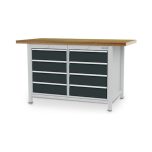
What load capacity and slide type do I need?
Two figures count: the load per drawer and the total capacity of the unit. Basic models carry 25 kg per drawer, robust industrial units with telescopic ball-bearing slides carry 75 kg and more. Make sure the rating applies to the fully open drawer, not just the closed one.
Full-extension slides free the whole drawer, so even the rear compartments are reachable without bending. Ball-bearing telescopic slides run smoother and quieter under load than simple roller slides and last longer.
Why are locking and castors decisive?
A central lock secures every drawer with one key and keeps unauthorised hands out. Just as important is an anti-tilt interlock that stops several drawers opening at once while the unit is moving, which would make it topple forward.
- Central lock: one cylinder secures all drawers at once.
- Single-drawer interlock: only one drawer opens at a time (anti-tip).
- Four swivel castors, two with a locking brake.
- Wheel diameter 75 to 125 mm to clear thresholds and cables.
- Elastic (TPE) tyres for sensitive or dissipative floors.
Frequently asked questions
How many drawers does a workbench unit need?
Four to eight drawers suit most workplaces. What matters is the mix of shallow drawers for small parts and deep ones for machines, not the raw number.
What does full extension mean for a drawer?
With full extension the drawer pulls 100 percent clear of the body, so the rear area is fully accessible. Partial extension frees only about 75 percent.
What is the drawer interlock for?
It allows only one drawer to open at a time. This stops several heavy drawers releasing while you move the unit, which would tip it forward.
What load should each drawer take?
Hand tools need 25 to 40 kg, while machines and heavy sets call for 50 to 75 kg per drawer at full extension.
Looking for the right drawer unit?
We supply mobile under-bench drawer units with full-extension slides, central locking and anti-tilt interlock - for workshop and ESD areas.
High capacity
Ball-bearing slides up to 75 kg per drawer.
Tip-safe
Anti-tilt interlock and a low centre of gravity.
Lockable
Central lock secures every drawer at once.
Selection help
We help you choose the right products; technical details are clarified with the manufacturer.