
Crimp, Solder or IDC - Which Contact Holds Best?
Whether a connector is crimped, soldered or contacted by insulation displacement decides reliability, vibration resistance and assembly effort. This guide compares the three methods by gas-tight joint, tooling and typical use cases and shows when each technique is the right choice.
To the guidesHow do crimping, soldering and IDC work?
All three methods create an electrically and mechanically sound joint between strand and contact, but along completely different routes. Crimping deforms the contact cold around the strand and forms a gas-tight cold weld. Soldering joins via liquid solder and capillary action. Insulation displacement (IDC) forces a sharp slot through the insulation directly onto the conductor.
During crimping the high compression makes contact and strand material flow into each other so that no air, and therefore no oxidation, reaches the mating surfaces. Soldering coats the strands with solder; the joint is tight, but the wires turn stiff and the transition to the flexible strand becomes prone to fracture. IDC cuts through the insulation and forms a gas-tight clamp with no stripping at all.
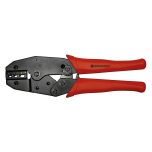 Choosing the right crimp tool
Which tool suits which contact and why the crimp has to be verifiable.
View productsWhich method is the most reliable?
For reliability under vibration and thermal cycling, crimping is the benchmark. It is standardised in IEC 60352‑2 as a gas-tight joint and stays flexible right up to the contact. Soldering shines on ground contacts and boards but is more vulnerable under continuous vibration.
- Crimp: best choice for vibration, moving cables and field assembly with no power.
- Solder: strong on ground planes, RF contacts and where no press tools are available.
- IDC: unbeatably fast on ribbon cables and near-series assembly.
- Never tin strand ends and then place them in a screw clamp - the solder creeps and the clamp loosens.
How do tooling and effort differ?
In practice effort often decides. Crimping needs a matching, calibrated tool per contact family, but the individual contact is set in seconds. Soldering needs only an iron yet costs noticeably more time and skill per joint. IDC is the fastest method once the right seating tool is on hand.
- Crimp: investment in a tool, but reproducible and easy to train.
- Solder: lowest tool cost, highest dependence on operator skill.
- IDC: no stripping, but conductor cross-section must exactly match the contact.
Frequently asked questions
Is a crimp joint really better than a solder joint?
For moving or vibrating cables, yes. The crimp is a gas-tight cold weld and stays flexible up to the contact, whereas the solder joint forms a rigid transition to the strand that can crack under bending cycles.
Can you screw tinned strands into a clamp?
No. The soft solder flows under pressure (creep), the clamp loosens and contact resistance rises. Use a wire-end ferrule instead.
What is insulation displacement (IDC) best for?
IDC is ideal for ribbon cable and fast series assembly because no stripping is needed. The conductor cross-section must match the contact slot exactly.
Do you strictly need a calibrated crimp tool?
For reliable, gas-tight crimps, yes. Only a matching tool with a defined press profile reproducibly reaches the crimp height and pull-out force required by IEC 60352‑2.
Looking for the right connection technique?
Whether crimp tools, soldering stations or IDC seating tools - tested connectivity gear ensures reliable, standard-compliant contacts. More in our guides.
Standard-tested
Crimp tools per IEC 60352-2 for gas-tight contacts.
Exact fit
Tool, contact and cross-section matched to each other.
Reproducible
Defined crimp height and verifiable pull-out force.
Selection help
We help you choose the right products; technical details are clarified with the manufacturer.