
ESD control in a cleanroom: how do you meet both requirements at once?
In a cleanroom, particle cleanliness and ESD control must be right at the same time. That demands low-outgassing, particle-free and yet dissipative materials. Because grounding options are limited and many surfaces are insulating, ionisation becomes central. This guide covers materials, garments, ionisation and the classes per ISO 14644-1.
View cleanroom ESDWhy must cleanroom and ESD be met together?
A cleanroom follows two rule sets at once: particle cleanliness to ISO 14644‑1 and ESD control to IEC 61340‑5‑1. A material must not trade one against the other - it has to be low-outgassing and particle-free and at the same time dissipative. Solutions that meet only one goal are ruled out.
The classic conflict: standard rubber mats and many soft plastics outgas and shed particles - not allowed in a cleanroom, even though they would be dissipative. Conversely, many cleanroom-compatible surfaces are insulating and build up charge. So you choose materials that are explicitly specified and documented for both requirements.
| Requirement | Cleanroom-compatible ESD solution | Feature |
|---|---|---|
| Work surface | dissipative cleanroom laminate, not a rubber mat | low-outgassing, particle-free, grounded |
| Flooring | dissipative cleanroom floor | no outgassing, defined resistance |
| Garments | cleanroom-compatible ESD coverall | grid fabric, particle-retaining |
| Insulating surfaces | ionisation | neutralises where grounding does not reach |
Which materials and garments are cleanroom-compatible?
Cleanroom-compatible ESD equipment is specified as low-outgassing and particle-free. Avoid standard rubber mats: they outgas and carry particles in. Instead use dissipative laminates, cleanroom floors and plastics released for the cleanroom - with a documented dissipation resistance.
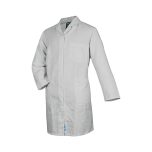
For garments, ESD and cleanroom function work together: cleanroom-compatible ESD coveralls with a conductive fibre grid retain the wearer's particles and shield the charge at the same time. They are complemented by dissipative cleanroom gloves and ESD cleanroom shoes with a defined through-resistance.
| Equipment | Cleanroom-compatible ESD solution | Purpose |
|---|---|---|
| Coverall | ESD cleanroom coverall with grid fabric | particle retention and shielding |
| Gloves | dissipative cleanroom gloves | low-particle, defined resistance |
| Shoes | ESD cleanroom shoes or overshoes | personnel dissipation via the floor |
| Mats | no standard rubber, cleanroom laminate | avoids outgassing and particles |
Why is ionisation so important in a cleanroom?
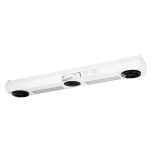
In a cleanroom the grounding options are limited and many surfaces stay insulating. Insulators cannot be drained - their charge can only be neutralised by ionisation. That is why ionisers here are not an add-on but often the only control for non-groundable surfaces.
All measures are documented to ISO 14644‑1 (cleanroom class) and IEC 61340‑5‑1 (ESD): material releases, measured dissipation resistances, ioniser checks (decay time, offset) and the periodic monitoring. The records prove that both requirements are met together over time.
| ISO class | Particles | Typical use |
|---|---|---|
| ISO 5 | very low | semiconductor, sensitive assembly |
| ISO 6 | low | board assembly |
| ISO 7 | medium | pre-assembly, packaging |
| ISO 8 | higher | less critical areas |
Frequently asked questions
Why no standard rubber mats in a cleanroom?
Standard rubber mats outgas and shed particles. That breaks the particle cleanliness to ISO 14644‑1. Use dissipative laminates and floors released for cleanroom use instead.
Why is ionisation so important in a cleanroom?
Grounding options are limited and many surfaces are insulating. Insulators cannot be grounded - their charge can only be neutralised by ionisation.
Which standards apply together?
For cleanliness ISO 14644‑1 with the cleanroom classes applies, for ESD control IEC 61340‑5‑1. Both requirements must be met at the same time and documented.
ESD equipment for your cleanroom
Low-outgassing, dissipative materials, cleanroom-compatible garments and ionisation - for ISO 14644-1 and IEC 61340-5-1 from a single source.
Standard-compliant
ISO 14644-1 and IEC 61340-5-1 met together.
Reviewed
Content reviewed by ESD specialists.
Full range
Materials, garments and ionisation from one source.
Selection help
We help you choose the right products; technical details are clarified with the manufacturer.