
How to choose a helping hands soldering tool
A helping hands tool holds boards, wires and components steady so both hands stay free for iron and solder. This guide compares clamp count, magnifier and stability and shows which design fits which job.
View helping handsHow many clamps does a good helping hands tool need?
The clamp count decides how many parts you can hold at once. Classic units carry two alligator clips on ball joints, while modern helping hands with flexible gooseneck arms often offer four to six holders for board, wire and component together.
Two clamps are enough to hold a wire against a terminal. For board work with several leads or connectors, four or more arms are far more comfortable because you avoid constantly re-clamping the workpiece.
Which magnifier makes sense for soldering?
An integrated magnifier helps with SMD parts and fine joints. Common values sit at 2x to 3x base magnification, often with a small 4x to 5x insert lens for close detail.
- Glass lens rather than acrylic: sharper image and scratch resistant.
- Lens diameter from 90 mm for a wide field of view.
- An LED ring light cuts shadows on the joint.
- Higher magnification shrinks field of view and working distance.
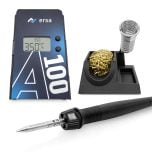 Choose a soldering station
Match temperature, power and tips to your helping hands setup.
View productsWhat makes a helping hands tool stable?
A heavy, wide base is decisive for steady work. A cast-iron foot weighing over 0.8 kg will not tip when you pull on an extended arm or press with the iron.
Ball joints must clamp firmly and not sag under load. Flexible gooseneck arms hold the set position as long as the metal is stiff enough. Non-slip rubber feet stop the base from wandering across the bench.
Frequently asked questions
How many clamps should a helping hands tool have?
Two clamps are enough for wires and simple joints. For boards with several connections, four to six flexible arms are far more practical because you avoid constant re-clamping.
Do I need a magnifier on the tool?
For SMD parts and fine joints, yes. 2x to 3x with a wide field covers most work; for very small parts an insert lens of 4x to 5x with LED light helps.
Why does my helping hands tool tip over?
Usually the base is too light. A cast foot from about 0.8 kg with a wide, rubberised footprint stays stable even with arms extended.
Do the clamps withstand the heat?
Quality silicone holders take over 300 °C and will not melt if the tip touches them. Bare plastic clamps are at a disadvantage here.
Looking for the right helping hands tool?
From the classic two-clamp holder to flex-arm units with magnifier and LED light - we help you pick the right design.
Wide range
From two-clamp holders to flex-arm systems.
Clear view
Helping hands with glass lens and LED light.
Stays put
Heavy cast bases for tip-proof work.
Selection help
We help you choose the right products; technical details are clarified with the manufacturer.