
How to choose an LED magnifier lamp for fine work
An LED magnifier lamp combines a magnifying lens with shadow-free light for precise close work. This guide explains diopters and magnification, the right lens diameter, colour temperature in Kelvin, and how to choose between clamp and rolling-base mounting.
View magnifier lampsContents
How many diopters does fine assembly need?
The refractive power of a lens is stated in diopters (dpt). Magnification follows the rule of thumb magnification = (diopters / 4) + 1. A 3-dpt lens therefore magnifies about 1.75x, a 5-dpt lens about 2.25x.
Higher diopter values give more magnification but shorten both the working distance and the field of view. For longer assembly tasks with a good overview, 3 to 5 dpt is ideal, while very fine inspection benefits from add-on lenses of 8 to 12 dpt for quick close-ups.
Which lens diameter and which light?
A large lens diameter widens the usable field of view and makes fatigue-free work easier. Common glass lenses measure 127 mm (5 inch) or 190 mm (7.5 inch); real glass is more scratch-resistant and has less distortion than acrylic.
For the light, colour temperature and colour rendering matter. Neutral white of 4000 to 4500 K feels comfortable, daylight white around 6000 to 6500 K delivers maximum contrast on solder joints and colour codes. A colour rendering index (CRI/Ra) above 90 shows component colours true to life.
- Real glass lens: scratch-resistant, clear and sharp to the edge.
- 127 mm for standard work, 190 mm for a large field of view.
- Edge-mounted LED ring provides shadow-free illumination.
- Colour temperature by task: 4000 K comfortable, 6500 K high contrast.
- CRI above 90 for true-to-life colour recognition.
- Dimmable models match brightness to the ambient light.
Clamp or rolling base - which mount fits?
The mounting decides flexibility and footprint. A table clamp saves space and fixes the lamp firmly to the table edge, while a rolling base makes the lamp mobile and usable across several workstations.
The spring-balanced arm matters too: a well-balanced arm with 90 to 100 cm reach holds every position without drifting and adjusts one-handed. For ESD workstations there are dissipative versions with an earth-bonding connection.
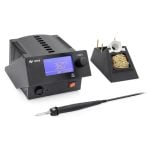 Choosing a soldering station
Matching soldering technology for clean joints under the lamp.
View productsFrequently asked questions
How do I convert diopters to magnification?
Use magnification = (diopters / 4) + 1. A 3-dpt lens therefore magnifies about 1.75x and a 5-dpt lens about 2.25x.
Which colour temperature is best for soldering?
Daylight white around 6000 to 6500 K gives the highest contrast on solder joints. Neutral white around 4000 K is more comfortable during long assembly. A CRI above 90 is important in both cases.
Clamp or rolling base?
The table clamp is space-saving and ideal for a fixed workstation. A rolling base makes the lamp mobile and suits use across several benches.
Glass or acrylic lens?
Real glass is more scratch-resistant, clearer and less distorted, especially at the edge. Acrylic is lighter and cheaper but wears faster.
Looking for the right LED magnifier lamp?
We supply LED magnifier lamps with glass lens, selectable colour temperature and clamp, rolling or wall mounting.
Right magnification
From 3 to 12 dpt for every fine task.
Flicker-free LED light
Shadow-free, dimmable and CRI above 90.
Large field of view
Glass lenses of 127 or 190 mm diameter.
Selection help
We help you choose the right products; technical details are clarified with the manufacturer.