
What are Metcal soldering and desoldering tips and what industrial applications do they serve?
Metcal soldering and desoldering tips are precision thermal tools designed for electronics manufacturing, repair, and rework operations in industries requiring ESD protection and temperature-controlled soldering. These cartridge-based tips utilize SmartHeat technology for consistent temperature regulation across SMD component attachment, QFP package soldering, PLCC component rework, and precision desoldering applications. Electronics manufacturers, aerospace companies, automotive suppliers, and medical device producers rely on these tips for high-reliability soldering work where thermal damage prevention and repeatability are critical requirements.
What technical criteria should guide selection of Metcal soldering tips for specific applications?
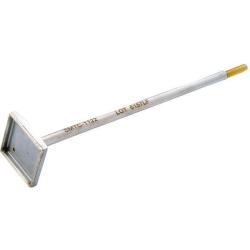
Metcal tip selection depends on operating temperature series, component geometry, and thermal mass requirements for your specific soldering application. The STTC series operates at 700°C/412°F for general-purpose work, while the STDC desoldering tips function at 600°C/357°F with precise diameter control from 0.7mm to 1.3mm for through-hole component removal. SMD-specific tips like the SMTC-145 for QFP-100 packages and SMTC-1124 for SOIC-16 components provide geometry-matched thermal transfer, while blade-type tips such as the SMTC-162 measuring 22x0.5mm enable precision rework on densely packed circuit boards.
Which international standards apply to Metcal soldering tips for industrial electronics manufacturing?
Metcal soldering tips conform to IEC 61340-5-1 standards for electrostatic discharge protection in electronics handling environments, ensuring ESD-safe operations during component soldering and rework processes. The tips meet ISO 9001 quality management requirements for consistent thermal performance and dimensional accuracy, while temperature calibration follows IEC 60068 environmental testing standards for reliable operation across industrial temperature ranges. Manufacturing facilities implementing these tips must maintain ESD control per ANSI/ESD S20.20 workplace standards, with proper grounding and ionization systems to prevent component damage during precision soldering operations.
What are the differences between STTC, SMTC, and STDC Metcal tip series?
The STTC series provides general-purpose soldering tips with integrated heating elements operating at 700°C/412°F, available in chisel geometries from 3.8x1mm to 5x7.6mm for conventional through-hole and surface-mount work. SMTC tips are specialized SMD soldering tools designed for specific component packages like QFP, PLCC, and SOIC, featuring precise thermal profiles matched to individual IC geometries for controlled heat transfer. STDC desoldering tips operate at 600°C/357°F with hollow construction and vacuum compatibility, offering diameter options of 0.7mm, 1.0mm, and 1.3mm for clean component removal without board damage.
What system compatibility and installation requirements apply to Metcal soldering tips?
Metcal soldering tips require compatible MX-series soldering stations or Talon rework systems that provide proper impedance matching for SmartHeat technology activation and temperature regulation. The STTC and SMTC tips connect to MX-series stations through proprietary cartridge interfaces, while TATC desoldering tips pair specifically with Talon systems for vacuum-assisted component removal. Installation involves simple cartridge insertion without calibration procedures, as each tip contains integrated temperature sensing and regulation circuits that automatically configure operating parameters based on tip geometry and thermal requirements for optimal soldering performance.
What safety ratings and operating temperature ranges characterize Metcal soldering tips?
Metcal soldering tips operate within defined temperature ranges of 600°C/357°F for desoldering applications and 700°C/412°F for standard soldering work, with integrated thermal regulation preventing temperature overshoot that could damage sensitive electronic components. The tips maintain ESD-safe operation through conductive pathways and proper grounding systems, meeting Class 0 ESD sensitivity requirements for handling MOSFET and CMOS devices. Operating ambient temperature range extends from 10°C to 40°C with relative humidity tolerance up to 80% non-condensing, while thermal recovery time remains under 3 seconds for consistent joint quality across production environments.
What maintenance schedule and service life expectations apply to Metcal soldering tips?
Metcal soldering tips require daily cleaning with damp cellulose sponges and weekly inspection for oxidation, geometric wear, or thermal response degradation that affects soldering quality. Service life typically ranges from 6 to 12 months under normal production conditions, with actual replacement intervals depending on operating temperature, flux chemistry, and daily usage hours. Preventive maintenance includes monthly calibration verification using temperature measurement devices, quarterly tip geometry inspection under magnification, and immediate replacement when temperature recovery exceeds 5 seconds or when visible wear affects joint formation consistency in critical electronics assembly operations.
Metcal soldering and desoldering tips use SmartHeat technology with fixed operating temperatures between 260 °C and 360 °C, regulated directly at the tip via RF induction at 13.56 MHz - eliminating setpoint drift and delivering <0.5 °C thermal overshoot under load. Tip series cover contact widths from 0.1 mm (UFTC ultra-fine cartridges) up to 18 mm chisel profiles (STDC/STTC), with iron-clad copper cores plated in nickel and chrome for >50,000 joint service life per IPC J-STD-001.
As an authorised Metcal distributor, esd.equipment stocks 333 tip and cartridge references across 8 series - SSC, STTC, STDC, PTTC, UFTC, TATC tweezer tips, SMTC rework tips, and solder cartridges - all compatible with the MX-500, GT-90, CV-5200, and OKi PS-900 handpieces. Every series meets IEC 61010-1 safety requirements and ESD protection to IEC 61340-5-1 (<1 Ω tip-to-ground path).
This website uses cookies to improve your experience. By clicking “Accept”, you consent to the use of ALL the cookies. However you may visit Cookie Settings to provide a controlled consent.