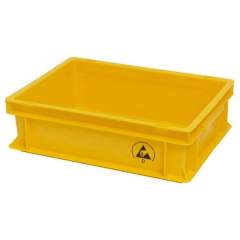
What are ESD-safe storage containers and which industries require them for component protection?
ESD-safe storage containers are electrically conductive or dissipative plastic containers designed to prevent static discharge damage to sensitive electronic components during storage and transport. These containers feature surface resistivity values between 10^6 to 10^11 ohms per square according to IEC 61340-5-1 standards, creating a controlled path for static electricity dissipation. Electronics manufacturing, semiconductor production, automotive electronics assembly, and aerospace component handling operations rely on these containers to protect ESDS (electrostatic discharge sensitive) devices worth thousands of euros from potentially catastrophic static damage.
What are the critical technical specifications when selecting ESD storage containers for industrial applications?
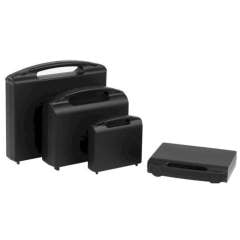
Critical selection criteria include surface resistance measurement between 10^4 to 10^11 ohms, container dimensions matching your component sizes such as the Warmbier 5311.Y.10.L model at 400x300x120mm, and material conductivity classification as either conductive or dissipative. Load capacity becomes essential for industrial stacking applications, with containers like the Hans Kolb 45-TSC rated for specific weight limits at 493x390x166mm dimensions. Color coding systems using yellow for dissipative and black for conductive materials enable instant identification in multi-user environments, while stackable designs with interlocking features maximize warehouse space efficiency.
Which international standards govern ESD storage container performance and certification requirements?
ESD storage containers must comply with IEC 61340-5-1 standard defining electrostatic discharge control requirements for electronics handling, including surface resistivity measurements and decay time specifications. ISO 3394 standard governs dimensional coordination for industrial containers ensuring compatibility across supply chains, while DIN EN 61340-5-1 provides European implementation guidelines for ESD control programs. ATEX certification becomes mandatory for containers used in explosive atmosphere zones, requiring intrinsic safety ratings and proper grounding procedures. These standards establish testing protocols for surface resistance, triboelectric charging, and electromagnetic compatibility ensuring reliable component protection.
What are the differences between conductive and dissipative ESD storage container variants?
Conductive ESD containers like the BLACKLINE series feature surface resistance below 10^6 ohms, providing rapid static charge dissipation for highly sensitive components requiring immediate grounding. Dissipative containers such as the IDP-STAT models exhibit controlled resistance between 10^6 to 10^11 ohms, offering slower but safer charge dissipation suitable for most electronic components. The Warmbier ableitfähiger containers in yellow indicate dissipative properties while black variants typically designate conductive materials, creating visual identification systems for technicians. Conductive containers require direct grounding connections while dissipative types can function effectively through ambient humidity and indirect grounding paths.
What installation and grounding requirements apply to ESD storage container systems?
ESD storage containers require proper grounding connections through conductive flooring systems or dedicated ground straps to maintain effective static dissipation pathways. Conductive containers need direct electrical connection to facility ground using minimum 16 AWG copper conductors, while dissipative containers function through capacitive coupling to grounded surfaces. Installation environments must maintain relative humidity between 45-55% according to IEC 61340-5-1 for optimal electrostatic control, with temperature stability between 16-35°C preventing material property changes. Container placement on ESD-safe workbenches or storage racks ensures continuous grounding path integrity throughout the component handling workflow.
What safety ratings and environmental specifications apply to industrial ESD storage containers?
Industrial ESD storage containers typically operate within temperature ranges from -40°C to +80°C depending on polypropylene or polyethylene construction materials, with specialized variants rated up to 120°C for elevated temperature applications. IP54 protection rating provides standard dust and splash resistance for manufacturing environments, while IP65 rated versions offer complete dust protection and water jet resistance for harsh industrial conditions. Material flame ratings comply with UL94-V0 or UL94-HB classifications ensuring fire safety in electronics manufacturing facilities, with some variants meeting automotive OEM specifications for temperature cycling and chemical resistance testing protocols.
What maintenance procedures and service life expectations apply to ESD storage container systems?
ESD storage containers require monthly surface resistance testing using calibrated electrometers to verify conductivity values remain within IEC 61340-5-1 specifications of 10^4 to 10^11 ohms per square. Industrial-grade containers typically provide 5-7 years service life under normal handling conditions, with quarterly cleaning using approved ESD-safe detergents maintaining optimal electrical properties. Annual inspection protocols include checking for crack development, lid seal integrity, and grounding connection continuity using 500V megohm testing procedures. Container replacement becomes necessary when surface resistance measurements exceed specified ranges or visible damage compromises structural integrity affecting component protection capabilities.
ESD storage containers (Lagerbehälter) provide controlled electrostatic discharge protection for sensitive components throughout storage and internal logistics workflows. Surface resistance values typically fall in the 10ⁱ-10⁷ Ω range per IEC 61340-5-1, ensuring safe charge dissipation without damaging voltage peaks. Conductive and dissipative variants meet the system grounding requirements defined under DIN EN 61340-5-2, making them suitable for verified EPA (Electrostatic Protected Area) environments where component integrity is non-negotiable.
esd.equipment stocks 60 Lagerbehälter ready for dispatch, spanning small-part trays, stackable bins, and ESD-safe magazine boxes from established manufacturers. Each product is verified for norm compliance with IEC 61340-5-1 and DIN EN 61340-2-3, giving procurement and quality engineers a single auditable source for EPA-compliant storage solutions across electronics manufacturing, semiconductor handling, and medical device assembly.
Key technical advantages - Lagerbehälter at a glance
⚡ 10ⁱ-10⁷ Ω surface resistance - dissipative range per IEC 61340-5-1, prevents charge accumulation on stored components
🛡 EPA-compatible system grounding - total system resistance < 3.5 x 10⁷ Ω per DIN EN 61340-5-2 for full EPA compliance
📦 60 products in stock - trays, bins, and magazine boxes available for immediate dispatch, no minimum order
⚙ Stackable modular design - standardized outer dimensions allow dense vertical storage and integration with ESD racking systems
🔍 Auditable norm compliance - products verified against IEC 61340-5-1 and DIN EN 61340-2-3 for quality-managed EPA environments
✓ Conductive and dissipative variants - select resistance class to match component sensitivity and EPA zone classification
Typical application areas:
Electronics manufacturing and SMT line feeding (IEC 61340-5-1, IPC-A-610), semiconductor wafer and die storage (SEMI S1/S2), medical device component handling (ISO 13485), automotive electronics sub-assembly logistics (VDA 6.3, IATF 16949), aerospace avionics kitting and traceability workflows (AS9100), and laboratory or R&D environments requiring documented EPA storage controls.
✓
IEC 61340-5-1 VerifiedAll containers tested for surface resistance within EPA-compliant dissipative or conductive range
📦
60 Products In StockTrays, stackable bins, and magazine boxes - available for immediate shipment from our warehouse
🛡
Full EPA System ComplianceDIN EN 61340-5-2 compatible - integrates with grounded ESD workstations, shelving, and transport systems
This website uses cookies to improve your experience. By clicking “Accept”, you consent to the use of ALL the cookies. However you may visit Cookie Settings to provide a controlled consent.