
Work chairs
Upholstered work chairs
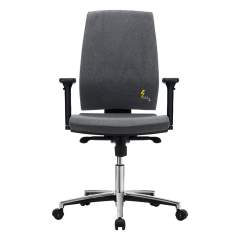
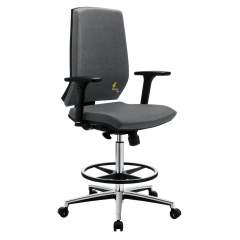
Upholstered work chairs and stools for assembly, test stations, laboratories and production: 583 models from Bimos, meychair, Grendene, Warmbier, Treston, Bosch Rexroth, Throna, Reeco and Bedrunka+Hirth. Seat heights from 370 to 930 mm, covers in fabric, Supertec, artificial leather or leather. 236 models are ESD versions.
Each card opens the range with the matching filter applied.
- 586 items
- 9 manufacturers
- Net prices plus VAT




Buying guide
How to choose Upholstered work chairs
What matters when choosing: properties, comparison and typical applications.
Selection criteria for upholstered chairs
Seat height
Seat about 280 to 300 mm below the work surface. From around 600 mm, a foot ring or step is needed.
Matching modelsMechanism
Weight adjustment (180 models) adapts backrest pressure, permanent contact (60) is robust in shift work.
Matching modelsCover
Supertec (70 models) is abrasion-resistant, artificial leather suits labs and medical practices.
Matching modelsESD
Use only models with ESD verification in the EPA. Grendene GREF and Bimos Basic are dissipative throughout.
Matching modelsSeries comparison
| Series | Brand | Seat height | Base | Cover, mechanism | ESD | Price from |
|---|---|---|---|---|---|---|
| TEXON | Bimos | 450-810 mm | Castors, glides | Artificial leather, 3D seat dynamics | 39 of 75 | from 598 EUR |
| Assistent | meychair | 390-890 mm | Glides, castors | Artificial leather, fabric | no | from 81 EUR |
| Workster | meychair | 460-930 mm | Castors | Fabric, seat tilt | 2 of 56 | from 155 EUR |
| Labsit | Bimos | 450-810 mm | Castors, glides | Fabric, Supertec | 8 of 51 | from 221 EUR |
| Neon XXL | Bimos | 470-640 mm | Castors | Supertec, synchronous mechanism | 24 of 48 | from 717 EUR |
| Basic | Bimos | 470-910 mm | Castors, glides | Fabric, permanent contact | all 40 | from 380 EUR |
| GREF Ergonomy | Grendene | 420-700 mm | Castors | Fabric, synchronous mechanism | all 20 | from 455 EUR |
ESD and standards
Charge flows from the person through cover, mechanism and base to conductive castors or glides and into the dissipative floor. Without such a floor the chair remains isolated. DIN EN 61340-5-1 requires a resistance from seat to ground point below 1 x 10¹⁰ ohms. Ergonomic requirements are described in DIN EN 1335.
Typical applications
Assembly and production, electronics manufacturing in the EPA, laboratories and test stations, medical practices and cleanrooms up to ISO class 3 (Bimos Labsit). Reinforced models carry up to 180 kg.