
Pliers and Cutting Tools
End and Oblique Cutters
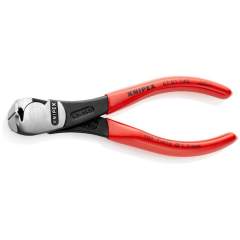
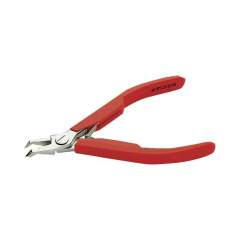
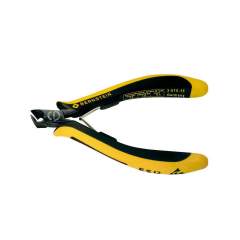
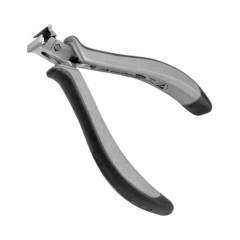
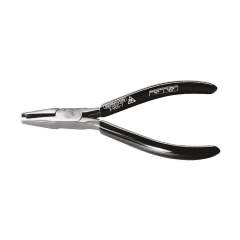
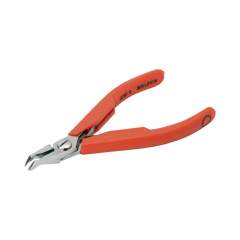
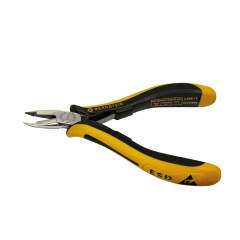
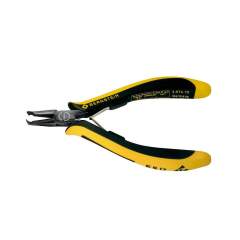
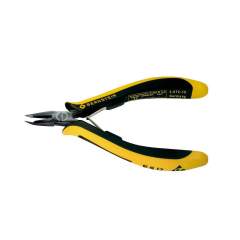
End cutters sever wire at right angles to the tool axis, while oblique end cutters and tapered head cutters reach solder joints between densely populated components. The range holds head angles of 11°, 15°, 20°, 29°, 30° and 45° and overall lengths from 115 to 200 mm. Electronics versions cover cutting capacities from 0.1 to 1.25 mm, heavy duty end cutters are rated for medium hard and hard wire. ESD models to IEC 61340-5-1 carry dissipative handle sleeves with a resistance to ground of 10⁶ to 10⁹ Ω. The category holds 144 items, among them Weller, Knipex, Lindström, C.K, Bernstein and Piergiacomi.
- 143 items
- 10 manufacturers
- Net prices plus VAT








Buying guide
How to choose End and Oblique Cutters
What matters when choosing: properties, comparison and typical applications.
Technical Features
Designs Compared
| Design | Head position | Cutting capacity | Use |
|---|---|---|---|
| End cutter | edge at right angles to the tool axis | 0.1 to 1.0 mm | flush cutting at the board |
| Oblique end cutter | angled 11° to 29° | 0.2 to 1.25 mm | access between adjacent components |
| Tapered head cutter | angled 30° to 45°, narrow tip | up to 0.8 mm | solder joints with poor access |
| Heavy duty end cutter | straight, 160 to 200 mm long | medium hard to hard wire | assembly and maintenance |
Typical Applications
Typical applications: flush trimming of component leads after soldering; work between closely spaced components with 45° tapered head cutters; cable assembly and stranded wire cutting; rework on boards inside the EPA; wire and nail work with heavy duty end cutters; precision mechanics and pattern making with miniature versions.