
How do I set up kanban with the two-bin system in the warehouse?
Kanban pulls replenishment from actual consumption instead of forecasts. In the two-bin system, the empty front bin triggers the reorder while the second bin covers the lead time. Sized correctly, stock stays lean and stockouts are avoided.
Explore storageWhat is the two-bin system?
The two-bin system is the simplest form of kanban: each item is held in two identical bins. Picking happens only from the front bin. When it runs empty, its card or the bin itself moves to the reorder point as a signal, while the second bin covers the lead time until the replenishment arrives.
This way actual consumption pulls the replenishment (pull principle) instead of ordering rigidly to plan. Stock stays lean because no more than two bins per item are ever held, and stockouts do not occur as long as the bin size covers the lead time.
How do I set up kanban step by step?
Setup follows four steps: measure consumption, determine lead time, size the bins accordingly, and define the reorder trigger. Each item gets two equally sized bins with a kanban card, arranged on a flow rack or bin shelf.
- Record daily consumption per item (average of recent weeks).
- Determine the supplier lead time in days, including a buffer.
- Bin size = daily consumption x lead time, plus a safety margin.
- Fill two identical bins per item, pick the front bin first.
- Place the empty front bin with its card at the collection point - this triggers the reorder.
- Store new stock behind the full bin (first-in-first-out).
Where does the two-bin system work best?
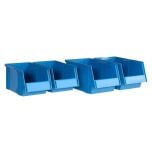
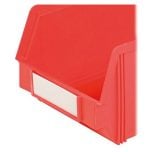
It works best on flow racks and in storage bins on bin shelves. On a flow rack the full bin slides forward automatically once the empty one is removed - the first-in-first-out flow happens on its own and the signal is visible at a glance.
For small C-parts such as standard parts, consumables or ESD accessories, kanban keeps the effort minimal. Clean warehouse labelling ensures that every bin maps clearly to one item and reorder point.
Frequently asked questions
How large should a kanban bin be?
Bin size comes from daily consumption times lead time plus a safety margin. That way one full bin lasts exactly long enough to bridge replenishment without hoarding stock.
What happens if both bins are empty?
Then the bin size was too small or the lead time too long. Two empty bins are a warning: increase the bin size or safety margin so the second bin reliably covers the lead time.
Is kanban suitable for all items?
It works best for items with steady consumption, such as C-parts, standard parts and consumables. For highly variable or very rare demand, individual demand-driven ordering is usually more sensible.
Equip your kanban storage correctly
We help with bin selection, sizing and rack setup for a lean two-bin system.
No stockouts
Correctly sized bins reliably cover the lead time.
Lean stock
Never more than two bins per item in circulation.
Clear signal
The empty bin triggers the reorder without counting.
Selection help
We help you choose the right products; technical details are clarified with the manufacturer.