What are ESD table mats and what industrial applications require them?
ESD table mats are electrostatically dissipative work surfaces that provide controlled discharge paths for static electricity, protecting sensitive electronic components during assembly, testing, and repair operations. These antistatic table coverings are essential in electronics manufacturing facilities, semiconductor production lines, telecommunications equipment assembly, and precision instrument calibration laboratories. Industries including automotive electronics, medical device manufacturing, aerospace avionics, and computer hardware assembly rely on ESD table mats to prevent component damage from electrostatic discharge events that can destroy integrated circuits and compromise product reliability.
What technical specifications should I consider when selecting ESD table mats?
Critical selection parameters for ESD table mats include surface resistivity typically ranging from 10^6 to 10^9 ohms per square, material thickness options from 1.5mm to 2mm as seen in Warmbier and Safeguard products, and roll dimensions up to 10000mm length by 1220mm width for continuous coverage. The mat material must demonstrate consistent electrical properties across temperature variations, chemical resistance to cleaning solvents and flux residues, and dimensional stability under mechanical stress. Surface texture affects component sliding and tool grip, while color coding helps identify different resistance grades and maintain visual organization in multi-zone work environments.
Which international standards govern ESD table mat performance and certification?
ESD table mats must comply with IEC 61340-5-1 standard for electrostatic discharge control in electronics manufacturing environments, which defines surface resistance limits and testing protocols for work surface materials. ISO 8516 specifies textile floor coverings with conductive properties, while ANSI/ESD S4.1 establishes worksurface resistance measurement procedures using concentric ring electrodes. European EN 100015 standard addresses ESD control requirements for manufacturing of electronic assemblies, and DIN EN 61340-4-1 defines standard test methods for characterizing the electrostatic discharge sensitivity of electronic devices that determine appropriate mat specifications.
What are the differences between Warmbier Ecostat and Safeguard Premium ESD table mat variants?
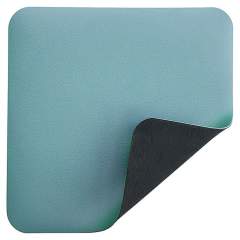
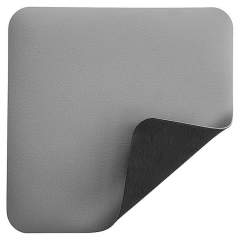
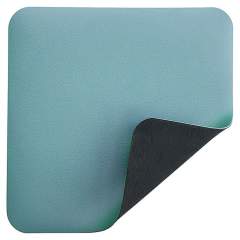
Warmbier Ecostat ESD table mats feature environmentally friendly formulations available in light blue and chip green colors with standard 2mm thickness and 1220mm roll widths, designed for general electronics assembly applications. Safeguard Premium ESD table covers offer enhanced durability construction in platinum grey, beige, green, and light blue options with identical 2mm thickness but available in both 1000mm and 1200mm roll widths for flexible installation requirements. Both product lines provide 10000mm roll lengths for continuous coverage, but Premium variants typically demonstrate superior chemical resistance and longer service life in high-throughput manufacturing environments.
How should ESD table mats be installed and connected to facility grounding systems?
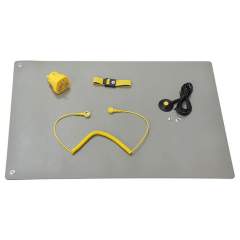
ESD table mats require direct electrical connection to facility ground through dedicated grounding points using snap fasteners, banana plugs, or ring terminals rated for continuous 1-megohm path resistance. Installation involves securing the mat to work surfaces using appropriate adhesives that maintain electrical continuity, positioning grounding hardware at recommended intervals typically every 3 meters for large installations. The grounding connection must pass through a current-limiting resistor typically 1 megohm value to prevent shock hazards while maintaining effective static discharge capability, and all connections require verification using calibrated resistance meters before operational use.
What environmental ratings and operating conditions do ESD table mats support?
Professional-grade ESD table mats operate effectively across temperature ranges from -10°C to +60°C while maintaining stable surface resistivity within specified limits, ensuring consistent electrostatic protection in climate-controlled manufacturing environments. These mats demonstrate chemical resistance to common industrial cleaning solvents, flux removers, and mild acids encountered in electronics assembly processes. The material construction provides mechanical durability against puncture and abrasion while maintaining flexibility for conforming to work surface contours, and UV-stable formulations prevent degradation under fluorescent and LED lighting typically found in electronics manufacturing facilities.
What maintenance procedures and service intervals are required for ESD table mats?
ESD table mats require daily visual inspection for cuts, punctures, or contamination that could compromise electrical properties, with weekly resistance testing using calibrated meters to verify surface resistivity remains within 10^6 to 10^9 ohms per square specification limits. Monthly deep cleaning with approved ESD-safe cleaning solutions removes flux residues and contaminants while preserving electrical characteristics, and quarterly documentation of resistance measurements ensures compliance with quality management systems. Typical service life ranges from 3 to 7 years depending on usage intensity and environmental conditions, with replacement indicators including surface cracking, permanent discoloration, or resistance values exceeding acceptable limits during routine testing protocols.