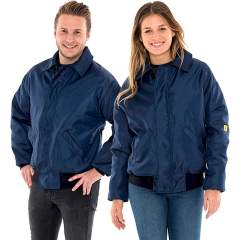
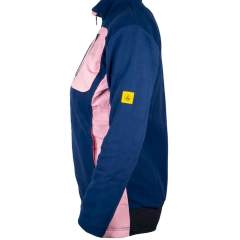
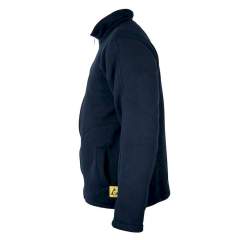
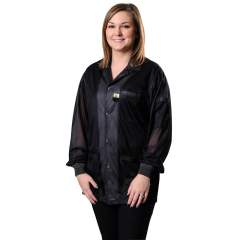
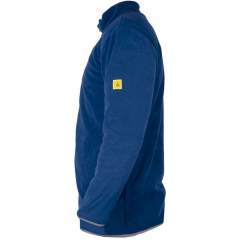
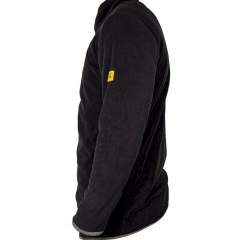
Images are examples, some edited with AI. The technical data are authoritative. AI notice
ESD Ladies Jacket Short Sleeve white, 155 g/m² conductive yarn fabric
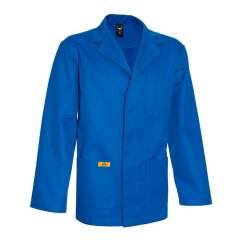
White short sleeve ladies jacket in 155 g/m² compact cotton yarn with polyester and 4 % conductive yarn. Lapel collar, sweat guard at the nape, concealed snap placket and three pockets. White shows every mark immediately, which is exactly what clean area work calls for. Surface resistance 10⁵ to 10⁷ ohms.
- Specialist dealer since 2009
- Invoice payment for regular customers
- Worldwide shipping
- Technical questions clarified with the manufacturer
Description
In quality assurance, cleanliness is not a feeling but a condition somebody has to be able to see. Whoever signs off assemblies, runs measurement series or works in the ante room of a clean area needs clothing that reveals a stain instead of hiding it. That is what white does, which is why this version usually ends up where particles and residue are part of the acceptance criteria.
The jacket weighs 155 g/m² and is 96 % cotton and polyester with 4 % conductive yarn. The short sleeve keeps wrist and forearm clear, which matters more at a microscope with tweezers and probe than any extra layer of fabric would. The lapel collar allows the jacket to be worn open without looking careless.
For the EPA coordinator the measured figure is what counts. STFI recorded a surface resistance of 10⁵ to 10⁷ ohms, placing the fabric in the dissipative range.
Your benefits
- Soiling becomes visible: Every fingerprint of grease and every flux splash stands out on white fabric. In a clean area ante room that is an advantage, because a soiled garment gets changed before it goes any further inside.
- 10⁵ to 10⁷ ohms measured: The figure comes from testing to DIN EN 61340-5-1:2016 at STFI, recorded at 23 °C and 25 % humidity. Dry air is the unfavourable case, and that is where the measurement was taken.
- Free forearm at the microscope: No cuff wipes across the stage and no fabric slides under the unit being inspected. Handling small components with tweezers is where that difference is felt.
- Compact spun rather than carded: Compact spinning binds fibre ends into the yarn. The fabric sheds very little, which saves cleaning time on test adapters, contact surfaces and exposed optics.
- Sweat guard at the nape: An extra layer of fabric sits where eight hours at a measuring bench first bring moisture. The collar keeps its shape and the jacket still looks presentable.
- Twelve sizes from 3XS to 6XL: A full shift can be equipped without compromising on fit. Anyone who needs 3XS or 6XL gets the same construction rather than a different model with different details.
- Designed for industrial laundry: White workwear goes to the laundry more often than dark. The jacket is built for that, and the conductive yarn keeps its conductivity across many cycles.
White as an operational decision
White is rarely ordered for aesthetic reasons. In clean area ante rooms, on the test floor, in metrology and in laboratories the principle holds that visible dirt beats hidden dirt. A greasy mark on a sleeve leads to someone changing the garment. On dark fabric the same mark would go unnoticed and keep brushing past the next assembly.
The second reason is outward effect. During customer audits and plant tours a clean white line signals a different standard than a mix of private clothing. For visitor and training areas it can be combined with a second colour so that guests and permanent staff are distinguishable at a glance.
Fabric and material
The fabric brings together 48 % cotton and 48 % polyester with 4 % conductive yarn at 155 g/m². Cotton supplies hand feel and moisture transport, while the polyester share keeps the jacket from shrinking after frequent processing and stops the shoulder area from twisting. The conductive yarn runs as a grid through the entire cut, not merely through selected zones.
- 155 g/m² fabric weight, wearable over a blouse all year round
- 48 % cotton, compact spun and therefore low in lint
- 48 % polyester for shape retention and short drying times
- 4 % conductive yarn, woven in rather than applied as a finish
- Reactive dyeing so the white does not drift towards yellow
Construction in detail
The front placket is concealed. The snap fasteners sit under the fabric, so leaning over an open assembly brings no metal into contact with a board or a housing. Bust darts at the sides shape the front panels and stop the jacket from gaping at the bench. At the nape an additional layer protects against moisture soaking through the collar area.
Pocket layout suits a workstation with paperwork and small tools. A patch chest pocket sits on the left, with two side pockets below featuring slanted openings that stay reachable seated or standing. The ESD logo is placed on the right side pocket, where it can be checked in passing during a walkthrough.
- Lapel collar with sweat guard at the nape
- Concealed snap fastener placket
- Patch chest pocket on the left
- Two side pockets with slanted openings
- Bust darts at the sides for shaping
- ESD logo on the right side pocket
Lasting dissipation and wash resistance
The dissipative property sits in the yarn rather than in a coating. That is why it is not the first thing to disappear during commercial processing. We work high grade silver yarn in a process developed in house. Conductivity is retained through repeated washing and wear.
With white garments this matters more than usual, because they are washed more often than dark ones. If a garment goes to the laundry twice as often, wash resistance is what decides the real cost per day worn. Temperature and process remain governed by the care label sewn into the garment.
Fit and size range
The jacket comes in twelve sizes, from 3XS through XXS, XS, S, M, L, XL and XXL up to 3XL, 4XL, 5XL and 6XL. It is cut as a women's garment, with bust darts rather than a straight unisex front panel. Binding measurements are listed in the size chart, provided as a PDF in the downloads tab of this product page.
Large sizes up to 6XL are part of the standard range. Smaller quantities ship directly from our warehouse, so kitting out a new colleague does not have to wait for a consolidated order. Once sizes are recorded properly, individual garments can be topped up later without holding up a whole department.
Applications
- Clean area ante rooms and gowning zones within an EPA
- Test floor, final inspection and assembly acceptance
- Metrology and calibration laboratories with sensitive instruments
- Semiconductor stores and picking of moisture sensitive parts
- Plant tours, audits and customer visits on the production floor
Care and service life
The jacket is suitable for commercial industrial laundering and designed for many processing cycles. The polyester share holds collar and shoulder in shape, and reactive dyeing keeps a clean white tone across the service life. The woven-in conductive yarn retains its conductivity through repeated washing. The care label in the garment governs the details.
Finishing and custom versions
Embroidery and print up to 160 °C are available, with a sample print recommended first. Company logos come out cleanly in their original colours on a white ground. Snap fasteners and pockets can be supplied in a contrast colour on request, as can special colours and finishes outside the catalogue. Talk to us for a quotation.
Standards and testing
Dissipative behaviour and surface resistance have been tested to DIN EN 61340-5-1:2016. STFI recorded 10⁵ to 10⁷ ohms in a test climate of 23 (+/-1) °C and 25 (+/-5) % relative humidity. Further ESD standards form the surrounding framework, but no testing or certification of this product against them exists.
Technical data
| Style | Ladies jacket, short sleeve, lapel collar |
|---|---|
| Colour | White |
| Material composition | 48 % cotton, 48 % polyester, 4 % conductive yarn |
| Fabric weight | 155 g/m² |
| Surface resistance | 10⁵ to 10⁷ ohms |
| Test climate | 23 (+/-1) °C, 25 (+/-5) % relative humidity |
| Test basis | DIN EN 61340-5-1:2016 |
| Test institute | STFI |
| Fastening | Concealed snap fastener placket |
| Pockets | Patch chest pocket left, two side pockets with slanted openings |
| Further details | Sweat guard at the nape, bust darts at the sides |
| ESD logo | On the right side pocket |
| Decoration | Printable up to 160 °C, suitable for embroidery |
| Care | Suitable for industrial laundering |
| Sizes | 3XS, 2XS, XS, S, M, L, XL, XXL, 3XL, 4XL, 5XL, 6XL |
| Customs tariff number | 6203.3310 |
| Brand | A1-ESD |
| Weight | 0.1 kg |
| Manufacturer | A1-ESD |
| GPSR manufacturer information | A1-ESD equipment GmbH. Keldersstr. 15, DE-42697 Solingen, www.esd.equipment |
| Condition of article | New |
| Article authenticity | Original product |
| Sales unit | 1 Stück |
| ESD version | ESD (antistatic) |
| Geschlecht | Women |
| Certification | IEC 61340-5-1 |
Downloads
Datasheet
Other
Questions about this item
Any other question?
Send us the item number and your question. We clarify technical details directly with the manufacturer and usually reply on the next working day.