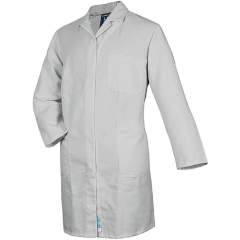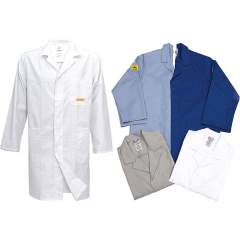
ESD lab coat Conductex long sleeve, women, royal blue - HB Schutzbekleidung HB-08005-48019-000-41
Item HB-0085
As low as
€68.80
Images are examples, some edited with AI. The technical data are authoritative. AI notice
This short-sleeve ladies' work coat is built for benches where flux residue, grease and toner dust are part of the day. Black keeps those marks discreet. The fabric of 48 % cotton, 48 % polyester and 4 % conductive yarn weighs 155 g/m² and measures 10⁵ to 10⁷ ohm surface resistance.
Anyone running an EPA knows how work coats fail. They sit differently after twenty washes, the fasteners scrape across housings, and the dissipative property turns into a claim nobody can measure. This coat was built around those three weak points.
The fabric combines 48 % cotton with 48 % polyester and 4 % conductive yarn. Cotton carries the handle and absorbs moisture across a full shift, polyester holds the cut and shortens drying time in industrial laundry. At 155 g/m² the coat stays light enough to wear over a blouse or T-shirt without adding bulk.
Black belongs where work is done rather than where visitors are received. Flux residue, solder smoke deposits, toner and machine grease show up on light fabric within days. On black they stay inconspicuous, and that has nothing to do with washing the garment less often.
The base is compact-spun cotton yarn blended with polyester, at 48 % cotton and 48 % polyester plus 4 % conductive yarn. Compact yarn has fewer protruding fibre ends than conventionally spun yarn, which is why the fabric sheds almost no lint onto open assemblies. Dimensional stability comes from the polyester share.
155 g/m² sounds modest and is exactly the right order of magnitude for a work coat. Heavy synthetic fabric traps heat above a soldering station, while a fabric that is too thin loses its contour quickly. This blend stays wearable across a full shift and still holds the shape a notched lapel collar needs.
The notched lapel collar hangs cleanly because the side bust darts pull the front of the coat into shape. This is not a fashion detail. A coat that creases across the chest drops onto the bench when the wearer leans forward, and that is exactly where components, boards and test adapters are lying.
The front closes with a concealed press-stud placket, the studs sitting under a fabric flap. A sweat guard at the neck absorbs moisture before it reaches the collar. The ESD logo is placed on the right side pocket, which keeps it visible while the wearer is seated at the workstation.
The conductive yarn is distributed through the fabric at 4 % and forms a continuous grid. It is not a coating that can wear away. The yarn used is high-grade silver yarn processed in a method of our own. Conductivity is retained after repeated washing and wearing.
For purchasing this is a service-life question. A coat that drops out of specification after thirty washes costs more than one that stays in stock. Testing at STFI produced 10⁵ to 10⁷ ohm at 23 (±1) °C and 25 (±5) % relative humidity, that is under dry conditions where charges are particularly persistent.
The coat is stocked in twelve sizes from 3XS to 6XL. That covers a mixed workforce without special orders, from a temporary hand in the test area to the shift supervisor. The oversizes from 3XL upwards run in the same cut and the same shade, so a repeat order fits the existing stock without a visible break.
Short sleeves suit warm production areas and stations where long sleeves get in the way, for example soldering benches, stereo microscopes and placement machines. Exact measurements per size are listed in the size chart in the Downloads tab of this product page.
Black is the pragmatic choice for areas with flux, solder paste, toner and grease. Those contaminants are mostly dark and barely register on black fabric. The visual condition of the garment stays presentable far longer, which is a practical argument for service technicians working at customer sites.
Black also has a limit. In cleanroom-adjacent zones where contamination should be visible, white is the better call, and cornflower blue works for marking whole teams. All three colours use the identical cut, so a mixed fleet of garments still looks consistent.
The coat is designed for industrial laundry. The polyester share keeps cut and length stable across many cycles, and the conductive yarn does not lose its conductivity in the process. We deliberately quote no wash temperature here, the sewn-in care label in the garment is the binding source.
Embroidery and printing up to 160 °C are possible, and a sample print in advance is recommended. A press stud or pocket in a contrasting colour, a company logo and further equipment details are implemented on request, as are special colours outside the catalogue range. Ask us for a quotation.
Dissipation and surface resistance were successfully tested to DIN EN 61340-5-1:2016 at STFI. The measured value is 10⁵ to 10⁷ ohm at 23 (±1) °C and 25 (±5) % relative humidity. No testing or certification to further ESD standards exists. The coat is one element of an EPA concept and replaces none of the other measures.
| Style | Ladies' coat, short sleeve, notched lapel collar |
|---|---|
| Colour | Black |
| Material | 48 % cotton, 48 % polyester, 4 % conductive yarn |
| Fabric weight | 155 g/m² |
| Surface resistance | 10⁵ to 10⁷ ohm |
| Test climate | 23 (±1) °C, 25 (±5) % relative humidity |
| Test institute | STFI |
| Test basis | DIN EN 61340-5-1:2016 |
| Closure | Concealed press-stud placket |
| Pockets | Chest pocket left, two side pockets with slanted openings |
| ESD logo | On the right side pocket |
| Further features | Sweat guard at the neck, side bust darts |
| Size range | 3XS to 6XL |
| Decoration | Printing up to 160 °C, suitable for embroidery |
| Sizes | 3XS, 2XS, XS, S, M, L, XL, XXL, 3XL, 4XL, 5XL, 6XL |
| Customs tariff number | 6211.4310 |
| Brand | A1-ESD |
| Weight | 0.1 kg |
| Manufacturer | A1-ESD |
| GPSR manufacturer information | A1-ESD equipment GmbH. Keldersstr. 15, DE-42697 Solingen, www.esd.equipment |
| Condition of article | New |
| Article authenticity | Original product |
| Sales unit | 1 Stück |
| ESD version | ESD (antistatic) |
| Geschlecht | Women |
| Certification | IEC 61340-5-1 |
Send us the item number and your question. We clarify technical details directly with the manufacturer and usually reply on the next working day.