
A1-ESD
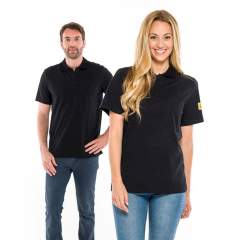
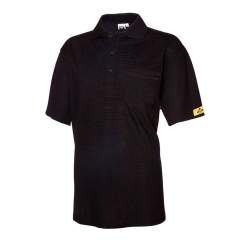
ESD polo shirt short sleeve black, 180 gsm piqué with conductive yarn
Item M200-180-1
As low as
€35.55
Images are examples, some edited with AI. The technical data are authoritative. AI notice
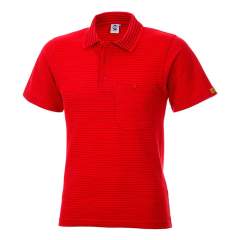
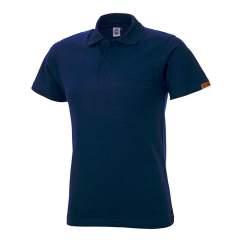
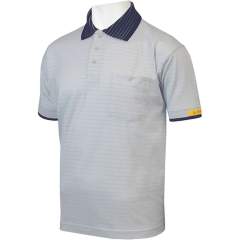
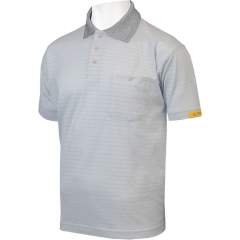
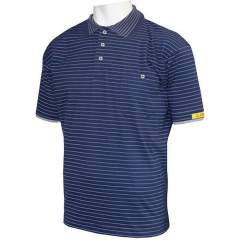
Short sleeve polo in white 180 gsm piqué, 96 % cotton with 4 % conductive yarn. Conductive rib knit collar, three button placket, left chest pocket and an ESD logo on the left sleeve. White shows contamination at once, which suits cleanroom ante areas, metrology rooms and test labs.
In cleanroom ante areas, calibration labs and semiconductor stores, cleanliness is not asserted but seen. White workwear makes every mark visible, and that is the point of it. A shirt carrying an oil streak gets noticed and goes to the laundry before the streak reaches an assembly.
The second half of the job is dissipation. Around 100 volts is enough to destroy a fine semiconductor structure, and the charge a person builds up simply by standing up from a chair sits far above that. This polo carries it away through 4 % conductive yarn in the knit instead of leaving it on a private sweatshirt.
Compact, low lint cotton serves both purposes. Fewer released fibres mean fewer particles on open boards and on optical surfaces.
The knit is 96 % compact cotton and 4 % conductive yarn. Both run through the same knitting process, so the conductive yarn belongs to the fabric rather than being added afterwards. For areas with raised cleanliness requirements the rest of the recipe matters just as much: cotton instead of synthetics means less self charging and less odour by the end of a shift.
Piqué holds its shape far better than plain single jersey and gives the white a calm, lightly textured surface. At 180 gsm the shirt still wears lightly but keeps enough substance not to look thin after many wash cycles. Ring spun yarn provides the smooth appearance.
At the neck sits a rib knit collar made from conductive yarn. It is elastic enough to close up again after being opened and keeps its height even when the shirt goes through commercial laundering every week. The three button placket allows an open collar at the test bench and a closed one in a customer meeting, without the neckline losing shape.
Inside, a colour matched neck tape covers the shoulder seam. It holds the neckline in shape and lies between the seam and the skin. The chest pocket sits on the left, the ESD logo on the left sleeve, so the marking stays visible even when an open coat is worn over the polo.
The conductive component is a silver yarn produced in a process developed specifically for this fabric. In practice this means dissipation lives in the thread and not in a coating that degrades with every wash. Conductivity is retained after repeated washing and wear.
For an EPA operator that translates into test routine. Where personnel garments are measured on a sample basis, wash resistance decides how often an item has to be replaced and how many spares need to sit in the cupboard. With white shirts, which go through the laundry more often than any other colour, that difference adds up quickly.
Twelve sizes from 3XS to 6XL cover an entire workforce, from an apprentice to the colleague who would otherwise have to shop outside the standard range. Cut, colour and handle stay identical across the whole run, including later repeat orders for new colleagues.
The size chart is available as a PDF in the Downloads tab of this product page and forms the basis for order quantities. White garments are usually changed more often than dark ones, so this colour deserves a larger buffer per person in the laundry loop.
White is the colour for cleanroom ante areas, metrology, calibration and final inspection. It draws a visible line between the production hall and the sensitive zone and makes checks simple, because anyone can see at a glance whether the clothing at a bench belongs there. For visitor tours and customer appointments white is also the colour from which cleanliness is read first.
The polo is made for commercial laundering, which is the decisive point with white because this colour goes through the loop more often than any other. Ring spun yarn and the piqué structure keep collar and hem in shape. Conductivity is retained over many washing and wearing cycles. Care instructions are on the sewn in label.
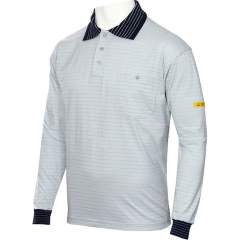
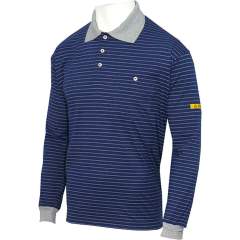
Printable up to 160 °C and suitable for embroidery, with a sample print recommended first. Decoration is carried out in Germany. Equipment options are available on request: sleeves with conductive knitted cuffs, a contrast execution, long sleeve with conductive rib cuffs and colours outside the catalogue. Talk to us and we will quote.
Dissipation and surface resistance were tested to DIN EN 61340-5-1:2016 at STFI and the test was passed. The measured value is 10⁵ to 10⁸ ohms, taken at 23 +/- 1 °C and 25 +/- 5 % relative humidity. Further ESD standards have not been tested for this model and no such claim is made.
| Style | Polo shirt, short sleeve, three button placket |
|---|---|
| Colour | White |
| Material | 96 % cotton, 4 % conductive yarn |
| Fabric weight | 180 gsm |
| Knit | Fine piqué from ring spun yarn |
| Collar | Conductive rib knit collar |
| Neck tape | Colour matched |
| Left chest pocket | |
| Marking | ESD logo on the left sleeve |
| Surface resistance | 10⁵ to 10⁸ ohms |
| Testing | DIN EN 61340-5-1:2016, tested by STFI |
| Test climate | 23 +/- 1 °C, 25 +/- 5 % relative humidity |
| Decoration | Print up to 160 °C, suitable for embroidery |
| Sizes | 3XS, 2XS, XS, S, M, L, XL, XXL, 3XL, 4XL, 5XL, 6XL |
| Customs tariff number | 6110.2091 |
| Brand | A1-ESD |
| Weight | 0.35 kg |
| Manufacturer | A1-ESD |
| GPSR manufacturer information | A1-ESD equipment GmbH. Keldersstr. 15, DE-42697 Solingen, www.esd.equipment |
| Condition of article | New |
| Article authenticity | Original product |
| Sales unit | 1 Stück |
| ESD version | ESD (antistatic) |
| Geschlecht | Unisex |
| Certification | IEC 61340-5-1 |
Send us the item number and your question. We clarify technical details directly with the manufacturer and usually reply on the next working day.